
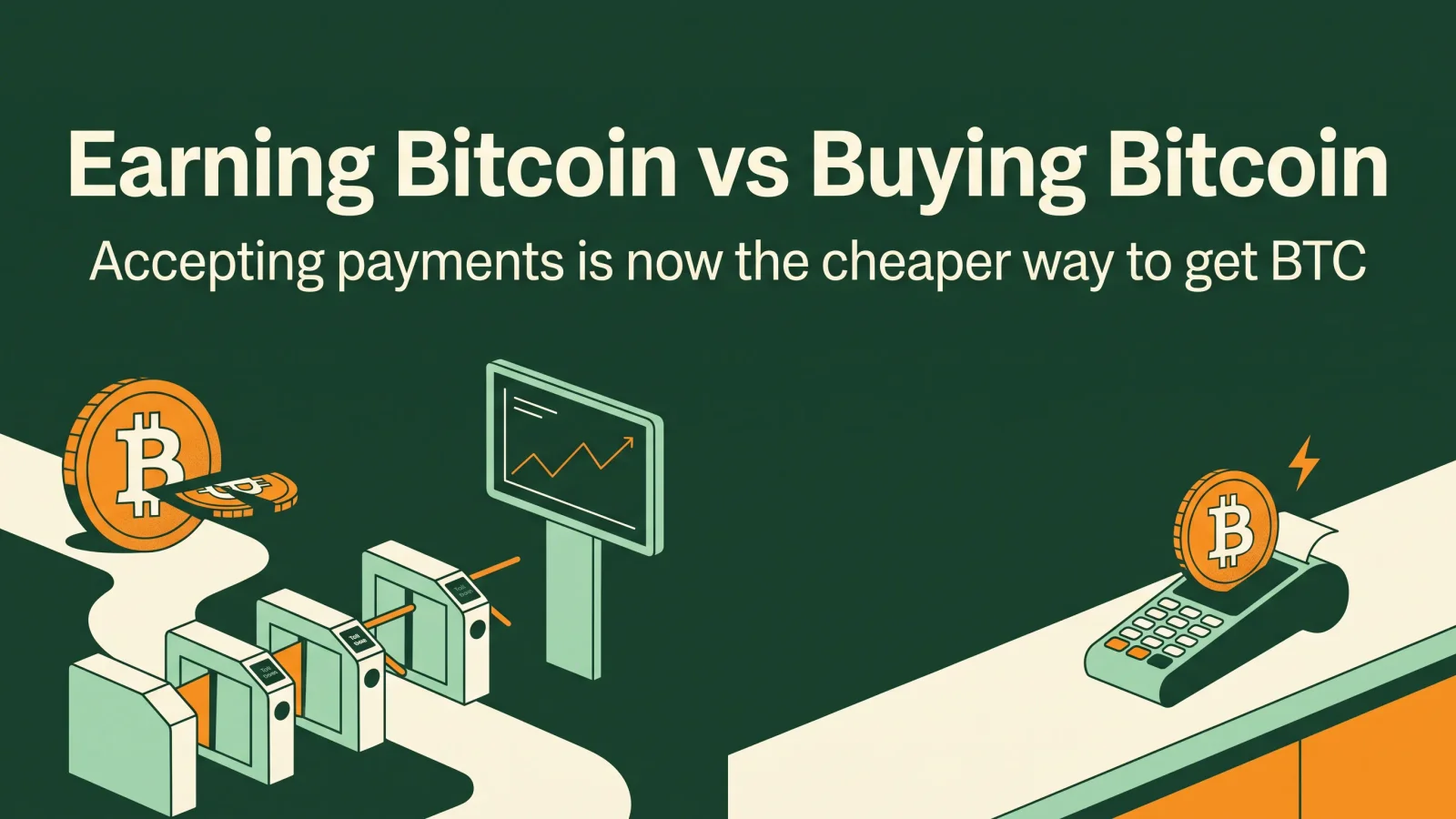
Accepting Bitcoin as payment and buying it through an exchange are two different ways for a business to acquire BTC. Compare the costs of each using your payment mix, agreed processing terms, and exchange fees. Amboss payment pricing is tailored to your business.
How much does it cost to turn business revenue into bitcoin?
Converting card revenue into bitcoin costs about 3.3% of the amount converted, before exchange spreads. The money passes through three tolls on the way: the card processor takes 2.9% + $0.30 per online transaction, the exchange takes a trading fee that starts at 0.40% for takers on Kraken Pro, and the withdrawal to your own custody pays an on-chain network fee.
| Step | Cost | Time |
|---|---|---|
| Card processing | 2.9% + $0.30 | Authorization is instant |
| Payout to your bank | Included | ~2 business days |
| Exchange purchase | 0.40% taker at entry tiers, plus spread | Minutes, once fiat arrives |
| Withdrawal to self-custody | Network fee, varies with congestion | ~10 to 60 minutes |
| Full path | ~3.3% + fixed fees | 3+ days |
The path is slow as well as expensive. Stripe's payout documentation sets US accounts at a two-business-day standard:
"If your Stripe account that operates in the United States has a standard T+2 settlement timing and you initiate a manual payout during business hours, the funds typically arrive in your bank account on the same business day."
A Friday sale is often not spendable until Tuesday, and only then can the exchange order go in. The withdrawal step adds a final variable cost: on-chain fees move with network congestion, and live rates are visible on the mempool.space fee tracker. Instant-buy products skip the wait but embed a spread on top of the trading fee, which pushes the all-in cost higher, not lower.
How much does it cost to earn bitcoin by accepting it as payment?
Amboss Payments lets your business accept Bitcoin through an API integration. talk to our team for pricing based on your payment volume and requirements.
Your proposal and wallet configuration determine the relevant costs. The Amboss Payments documentation explains the integration.
Reliability at business scale is measured, not assumed. River's 2023 Lightning report recorded a 99.7% payment success rate across 308,000 payments, tracing nearly every failure to liquidity placement rather than the protocol. The network was designed against the throughput of card rails from the start. The Lightning Network whitepaper framed the benchmark plainly:
"The payment network Visa achieved 47,000 peak transactions per second (tps) on its network during the 2013 holidays, and currently averages hundreds of millions per day."
Live capacity, node counts, and fee data for the network are tracked on the Amboss Lightning network stats page.
How should you compare the two paths?
For purchases, include card processing costs if applicable, exchange fees, spreads, and withdrawals. For payment acceptance, include your agreed processing terms, integration costs, and any conversion you need after settlement.
Apply both calculations to the same amount of revenue. Savings depend on the proposal and on how many customers choose to pay in Bitcoin.
When does buying bitcoin still make sense?
Buying still makes sense when the money is already sitting in a bank account. An exchange purchase at 0.40% is a reasonable way to deploy idle treasury cash, because the card-processing toll was paid long ago and cannot be recovered. The earning advantage applies specifically to new revenue: money that has not yet entered the card stack.
Two more honest constraints. Earning scales with your payment volume, so a business that wants to acquire bitcoin faster than customers pay in it will still buy the difference. And the share of customers who pay in bitcoin varies by market; businesses with global, online, or crypto-native customer bases see the highest uptake. Price exposure is identical on both paths: a dollar of bitcoin earned and a dollar of bitcoin bought carry the same volatility, so the accounting treatment is the deciding factor, not the acquisition method.
Amboss Payments connects Bitcoin and stablecoin acceptance to your website or app. Discuss receiving wallet options and commercial terms with the team. Fiat conversion, if needed, requires a separate arrangement.
Frequently asked questions
Is it cheaper to earn bitcoin than to buy it?
It depends on your processing agreement, exchange fees, settlement requirements, and customer demand. Compare an actual payment proposal with the costs of buying the equivalent amount of Bitcoin.
How can a business earn bitcoin without mining?
Accept it as payment. Mining requires hardware, electricity contracts, and operational scale, and the capital cost per bitcoin earned is far above the market price for most entrants. Accepting bitcoin at the point of sale requires a payments integration and acquires bitcoin in exact proportion to real customer demand rather than hash rate.
Do I pay taxes on bitcoin earned as payment?
In most jurisdictions, bitcoin received as payment is recognized as ordinary revenue at its fair market value on the date received, the same as fiat revenue. Later price changes are typically treated as capital gains or losses when you sell or convert. Rules differ by country, so confirm the treatment with a tax advisor before switching a meaningful share of revenue.
What do I need to start accepting bitcoin payments?
A payments provider that handles invoicing and settlement, and a decision about custody. With the Amboss Payments API, payments settle over Lightning to infrastructure the business controls, so there is no intermediary holding funds. Integration is a standard API project measured in days, and customers pay from any Lightning-enabled wallet or exchange account they already use.
Does bitcoin's volatility make earning it risky?
The volatility is identical however you acquire it: a dollar of bitcoin earned moves the same as a dollar of bitcoin bought. The relevant question is what share of revenue you want in bitcoin at all. Businesses that want none convert immediately through a partner. Businesses should compare actual acquisition costs under their payment and exchange agreements.