
When we talk to teams evaluating Amboss for the first time, we often hear some version of the same sentence: "You do Lightning analytics, right?"
It is a fair assumption. It is also five products out of date.
Amboss today operates a full payment stack: a liquidity marketplace, a compliance platform, a self-custody yield product, and a payments API that settles USDT, USDC, and BTC in seconds. Analytics is where the story starts, not where it ends. And the reason the stack works is the same reason people remember us for analytics in the first place. For more than five years, we have been collecting and modeling data on how money actually moves through the Lightning Network, at a depth no one else has.
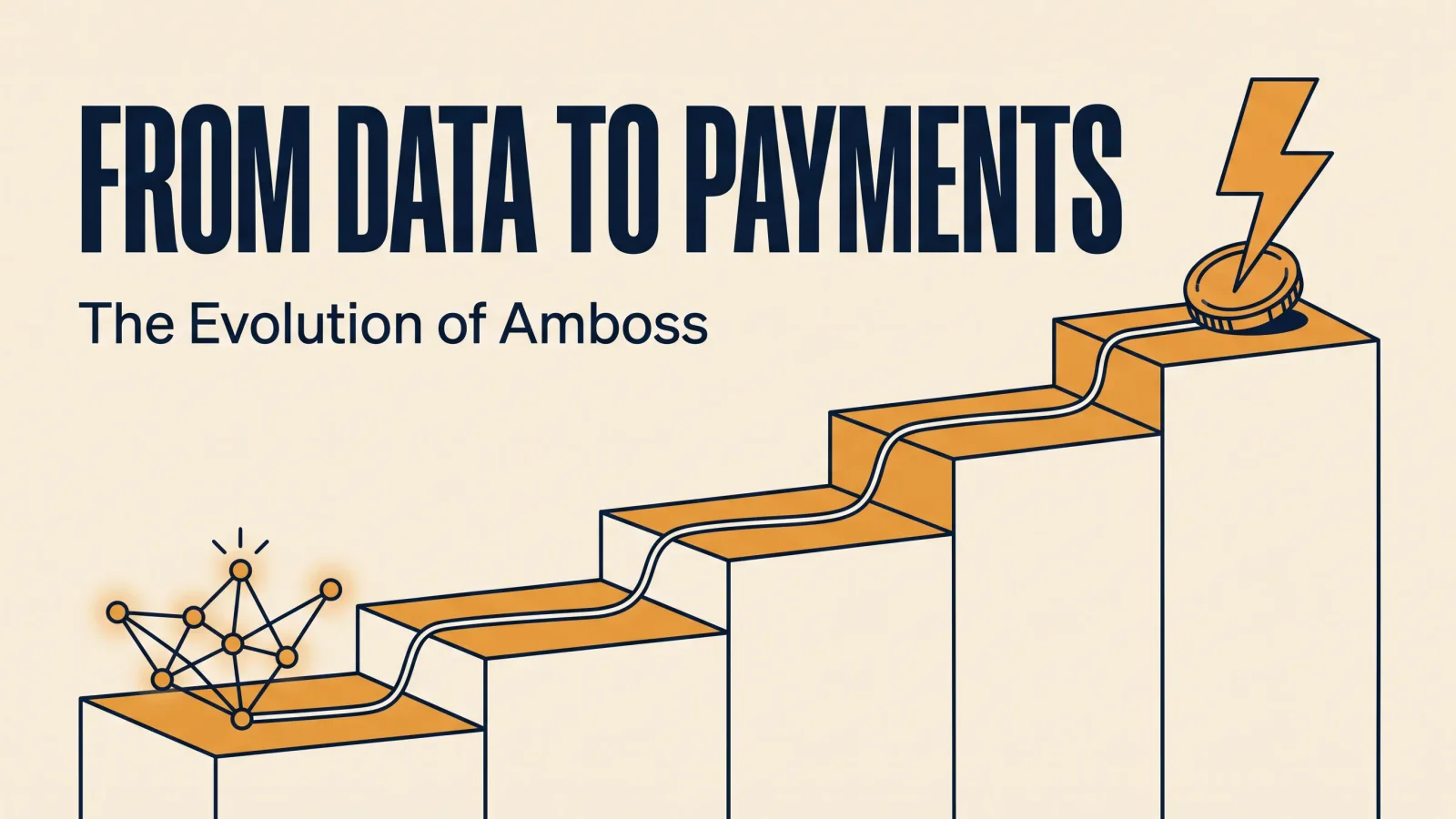
This post walks through that evolution, product by product, because the sequence is the point. Each product exists because the data from the previous one showed us exactly what to build next.
2021: Space, the Map of the Network
We started with Amboss Space, a Lightning Network explorer and analytics platform. Space gave node operators something the network badly needed: visibility. Which nodes were reliable. Where channels existed. How liquidity was distributed. How the topology changed over time.
Space became the standard way to see the Lightning Network, and that mattered commercially in a way that was easy to underestimate at the time. While everyone else saw a dashboard, we were building a continuously updated record of the network itself: every node, every public channel, every policy change, every shift in topology, accumulating day after day.
That dataset is the moat. Lightning is a living network, and you cannot reconstruct its history retroactively. A competitor starting today can copy any feature we ship. They cannot copy five years of observation.
2022: Magma, the Marketplace the Map Revealed
Once you can see an entire payment network, you see its inefficiencies. The data showed a clear one: liquidity was in the wrong places. Some nodes desperately needed inbound capacity, while others had capital sitting idle. There was demand on both sides and no market connecting them.
So we built the market. Magma launched in April 2022 as a peer-to-peer marketplace for Lightning channels: operators who need liquidity buy it, operators with capital sell it, and pricing is driven by real supply and demand. Magma grew into Lightning's largest liquidity marketplace.
Magma also deepened the moat. On top of network topology, we now had marketplace data: what liquidity costs, where demand concentrates, how long purchased channels survive, and which sellers earn repeat buyers. In December 2024 we turned that into Magma AI, the first machine learning powered channel recommender for Lightning, trained on outcomes that only exist in our dataset.
2024: Reflex, the Compliance Layer Institutions Asked For
As Magma grew, the profile of who called us changed. Exchanges, custodians, and fintechs wanted to operate on Lightning, and they all hit the same wall: their compliance teams had no tooling for a peer-to-peer payment network.
Reflex is our answer. It automates sanctions screening, IP-based node analysis, and OFAC checks across channels and payment peers, with exportable audit reports that compliance teams can actually file.
Here is the part that gets missed: a compliance product like Reflex is only credible if you can identify and score counterparties across the whole network, historically and in real time. That capability does not come from a compliance rulebook. It comes from the graph. Reflex is the data moat pointed at risk instead of routing.
2025: Rails, Capital Meets the Network
By 2025 the picture from the data was consistent: payment volume on Lightning was growing, and the constraint on serving it was capital. The network needed more liquidity than node operators alone could supply, and institutions holding Bitcoin wanted productive uses for it that did not involve handing it to a lender.
Rails connects those two facts. It deploys your Bitcoin and stablecoins into Lightning liquidity provision and payment routing, generating yield from real payment activity while you keep complete custody. No lending, no rehypothecation, no counterparty holding your funds.
What makes Rails work is allocation, and allocation is a data problem. Deciding where capital earns on Lightning means predicting routing demand across thousands of nodes, which is exactly what five years of network data and our machine learning research make possible.
2026: Amboss Payments, Where Everything Converges
Each product so far solved one layer of a problem: visibility, liquidity, compliance, capital. Amboss Payments is what they add up to.
Payments lets businesses send, receive, and settle USDT, USDC, and BTC in seconds, globally, for near-zero fees, through one API. Sub-second finality, no chargebacks, full self-custody.
Under the hood, it is the whole stack working at once:
- Routing intelligence from the Space dataset and our ML research (including MPFlow, our published work on payment flow optimization) finds the fastest, cheapest path for every payment
- Liquidity comes from Magma's marketplace and the capital Rails deploys
- Compliance comes from Reflex, integrated directly into payment operations
- Reliability comes from five years of knowing, empirically, which routes work
A payments company that starts at the API layer has to buy or guess all of that. We grew it, in order, from the data up.
The Pattern: Data First, Products Second
Laid out end to end, the sequence looks deliberate, and it was. But the strategy was not a product roadmap. It was a commitment to owning the best data on the network and letting it tell us what to build.
| Product | Launched | What it does | What the data contributes |
|---|---|---|---|
| Space | 2021 | Network analytics and node intelligence | The foundational dataset itself |
| Magma | 2022 | Liquidity marketplace | Pricing, demand, and channel performance |
| Reflex | 2024 | Sanctions screening and risk management | Counterparty identification across the graph |
| Rails | 2025 | Self-custody yield on BTC and stablecoins | Predicting where capital earns |
| Payments | 2026 | Instant global settlement in USDT, USDC, BTC | Routing intelligence for every payment |
Each product also feeds data back in. Magma taught us what liquidity is worth. Rails teaches us how routing performs under real capital. Payments teaches us how settlement behaves at scale. The moat compounds.
What This Means If You Are Evaluating Us
If you came to Amboss for analytics, you are in the right place, and there is more here than you expected.
If you are a business that wants to settle stablecoin or Bitcoin payments instantly, start with Amboss Payments. If you hold Bitcoin and want it productive without giving up custody, look at Rails. If your compliance team is the blocker, Reflex was built for them. And if you operate Lightning infrastructure, Magma and Space remain the tools the network runs on.
Five years ago we set out to understand a payment network better than anyone. It turns out that when you do that, you end up building the payment network. Book a discovery call and we will show you what the data can do for you.