
RailsX Is Live: The Global Economy Deserves Truly Decentralized Financial Infrastructure
Every financial system has made the same tradeoff. Accessing real economic utility, whether that means trading, holding diverse assets, or moving value across currencies, has required surrendering control of your money to someone else. Banks, exchanges, custodians, clearinghouses. The infrastructure of global finance is essentially a network of trusted intermediaries, and participation has always meant accepting their terms, their fees, their gatekeeping, and their risk.
Bitcoin was built to prove that this tradeoff is a mirage. Bitcoin demonstrated that a monetary network can be fully decentralized, that no single entity can freeze your funds or deny your transaction, and that the rules of the system cannot be changed by any authority unilaterally. What Bitcoin could not do, until now, was extend those properties to trading, stablecoins, and foreign exchange.
That changes today with RailsX.
The Demands of the Global Economy
The foreign exchange market settles $9.5 trillion per day. It is the largest financial market in the world, and it exists because the global economy runs on multiple currencies. Businesses, individuals, and institutions need to convert assets, hold stable values, and trade across currency pairs continuously. Correspondent banks, FX desks, clearinghouses, and centralized exchanges serve that demand efficiently within their own logic, but they extract significant cost and restrict who may participate and on what terms.
DeFi attempted to answer this demand without the gatekeeping, but it introduced new dependencies and centralization vectors. Decentralized exchanges on Ethereum and its L2s require bridges to move assets from Bitcoin, broadcast every transaction publicly, carry gas costs that make small trades uneconomical, and depend on oracles and centralized token issuers at the edges. The decentralization was partial. The result was a system that looked different from TradFi but reproduced many of the same failure modes under a different set of operators.
Bitcoin, through the Lightning Network and Taproot Assets, can now serve the demand for DeFi without those compromises. RailsX is the infrastructure that makes decentralized trading possible on Bitcoin itself.
How RailsX Trading Works
The technical foundation of RailsX is a property that has always been native to Lightning: atomic payments. A payment on Lightning either completes in full or it does not complete at all, with no partial settlement and no counterparty holding funds in between.
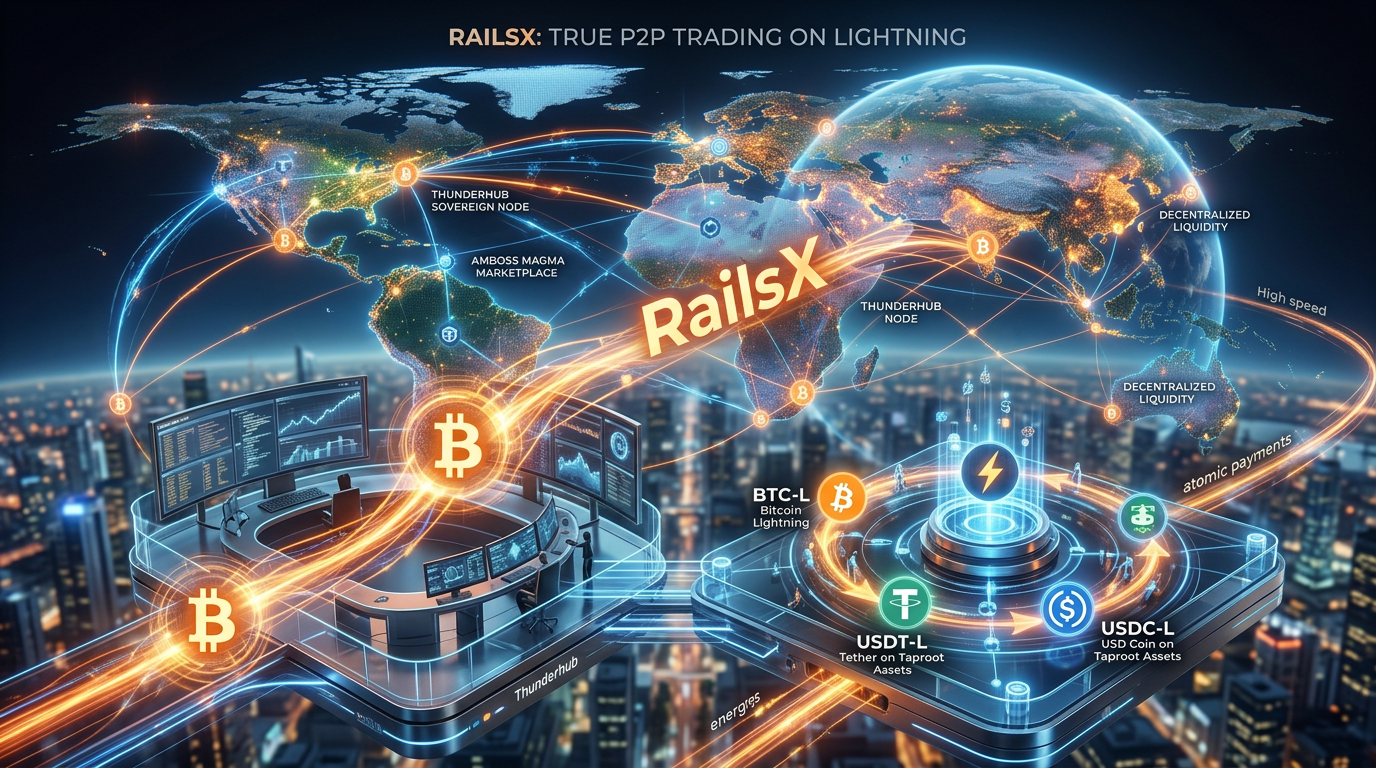
RailsX extends this property to cross-asset trading through circular payments. A trade begins in a bitcoin Lightning channel, routes through the network, and completes in a Taproot Asset channel denominated in a stablecoin such as USDT-L or USDC-L. Because the payment is atomic end-to-end, the swap between bitcoin and the stablecoin is atomic as well. There is no risky bridge, no secondary blockchain, no utility token, and no controlling intermediary at any point during the trade.
RailsX makes peer-to-peer finance possible on Bitcoin through Lightning. Taproot Assets is a Bitcoin-native protocol that allows any asset to be represented and transacted efficiently on Bitcoin, inheriting its security properties and settling on the Lightning Network at near-zero cost. Once an asset exists on Taproot Assets, Rails Liquidity Providers can make that asset available for trading to any Lightning node operator in full self-custody, without requiring changes to intermediate nodes.
For Lightning node operators, this architecture turns channel rebalancing into portfolio management. The circular payments that node operators already execute to manage liquidity between channels now become the mechanism for shifting exposure between bitcoin and stablecoins. The infrastructure you already run becomes a P2P trading platform.
Thunderhub: Sovereign Access at Scale
We built RailsX to reach as many Lightning nodes as possible, and the right delivery vehicle for that is Thunderhub. Thunderhub is fully open-source software that Lightning node operators already run to manage their nodes. To access RailsX Trading, update Thunderhub to the latest version and connect litd. Trading is available directly within your existing node interface, with no new installation required.
To source Taproot Asset channel liquidity, you can access providers directly through Thunderhub. We've equipped our Rails Liquidity Provider nodes to function as edge nodes, interfacing between Taproot Asset channels and the broader bitcoin Lightning Network, so that the supply of liquidity for cross-asset trading can scale with demand.
Thunderhub also supports scripting, which means that spot trading is only the beginning of what a node operator can do. A node running RailsX can define conditions and automate responses to price levels, effectively running limit orders from within its own infrastructure. The platform places control in the hands of the operator rather than the platform.
Speed Wallet: Established Assets Now Available to the Broader Lightning Network
The stablecoins available on RailsX at launch are not new experiments; they're assets with a proven track record on Lightning, pioneered by Speed Wallet before any other team brought them to Lightning.
Speed was among the earliest builders to recognize that Taproot Assets could bring stablecoin utility to Bitcoin. While the broader industry was still debating whether stablecoins belonged on Lightning at all, Speed was shipping. Speed built USDT-L and USDC-L as wrapped stablecoins on Taproot Assets and deployed them inside Speed Wallet, a production Lightning application serving users. That work validated both the technology and the demand.
What changes with RailsX is distribution. Speed's established assets are now available to any Lightning node operator running Thunderhub, in full self-custody, through Magma's liquidity infrastructure. Users do not need to hold funds in Speed Wallet to access these assets. They source Taproot Asset channels from providers in Magma or Thunderhub and trade directly from their own node. Speed built the asset layer. Amboss built the distribution layer. Together, they bring stablecoin liquidity to the sovereign Lightning Network at scale.
This partnership reflects how Bitcoin's open ecosystem is supposed to work. An innovator solves a hard problem and builds something that works. An infrastructure layer extends that solution to a broader audience without requiring anyone to give up custody in the process.
The Full Stack: Rails, RailsX Trading, and Magma
RailsX Trading is an extension of Magma, Lightning's largest liquidity marketplace. Decentralized liquidity providers supply the depth of liquidity to Magma in both bitcoin and Taproot Assets, enabling large trade sizes with leased liquidity.
Rails Liquidity Providers automatically provide liquidity to Magma, capturing leasing fees without sacrificing custody. Liquidity providers also earn fees from trading activity (cross-asset routing) through the same mechanism that routing nodes earn fees from payment forwarding. Together, Rails LPs provide the liquidity and automated market making service to RailsX Trading, enabling a complete system of self-custody products that enable efficient trading and treasury management.
In partnership with Magnolia and Bringin, RailsX supports on and off ramps to traditional banking rails in the US and Europe, enabling users to convert between fiat currencies and Bitcoin or stablecoins when needed. The full path from a fiat bank account to self-custody trading and back is available through open-source software.
Get Started
RailsX is live today through Thunderhub. Updating to the latest version gives you access to trading directly from your node. If you are new to Thunderhub, a step-by-step setup guide is available at thunderhub.io.
To source Taproot Asset channel liquidity, browse providers within Thunderhub.
For institutions and liquidity providers interested in listing assets on RailsX, please contact [email protected].
We announced RailsX in January at the PlanB Forum in El Salvador. The response confirmed the scale of demand for sovereign, self-custody trading on Bitcoin. That demand has existed for a long time. The infrastructure to serve it properly now exists as well.
Jesse Shrader is the CEO and Co-Founder of Amboss Technologies, which builds intelligence, liquidity, and trading infrastructure for Bitcoin's Lightning Network. Amboss products include Magma (Lightning's largest liquidity marketplace), Rails (self-custody yield on Lightning), RailsX (Lightning-native P2P trading), Space (Lightning Network analytics), and Reflex (compliance tooling for regulated businesses).