
Payment processors ban peptides because the category combines three risks they cannot price: regulatory action, card-network dispute limits, and rules set by their partner banks. The FDA has sent warning letters to peptide sellers whose "research use only" labels did not match their marketing, and Visa flags high-volume merchants whose combined fraud and dispute ratio reaches 1.5%. Most processors decide it is cheaper to refuse the whole category.
Why do payment processors ban peptides?
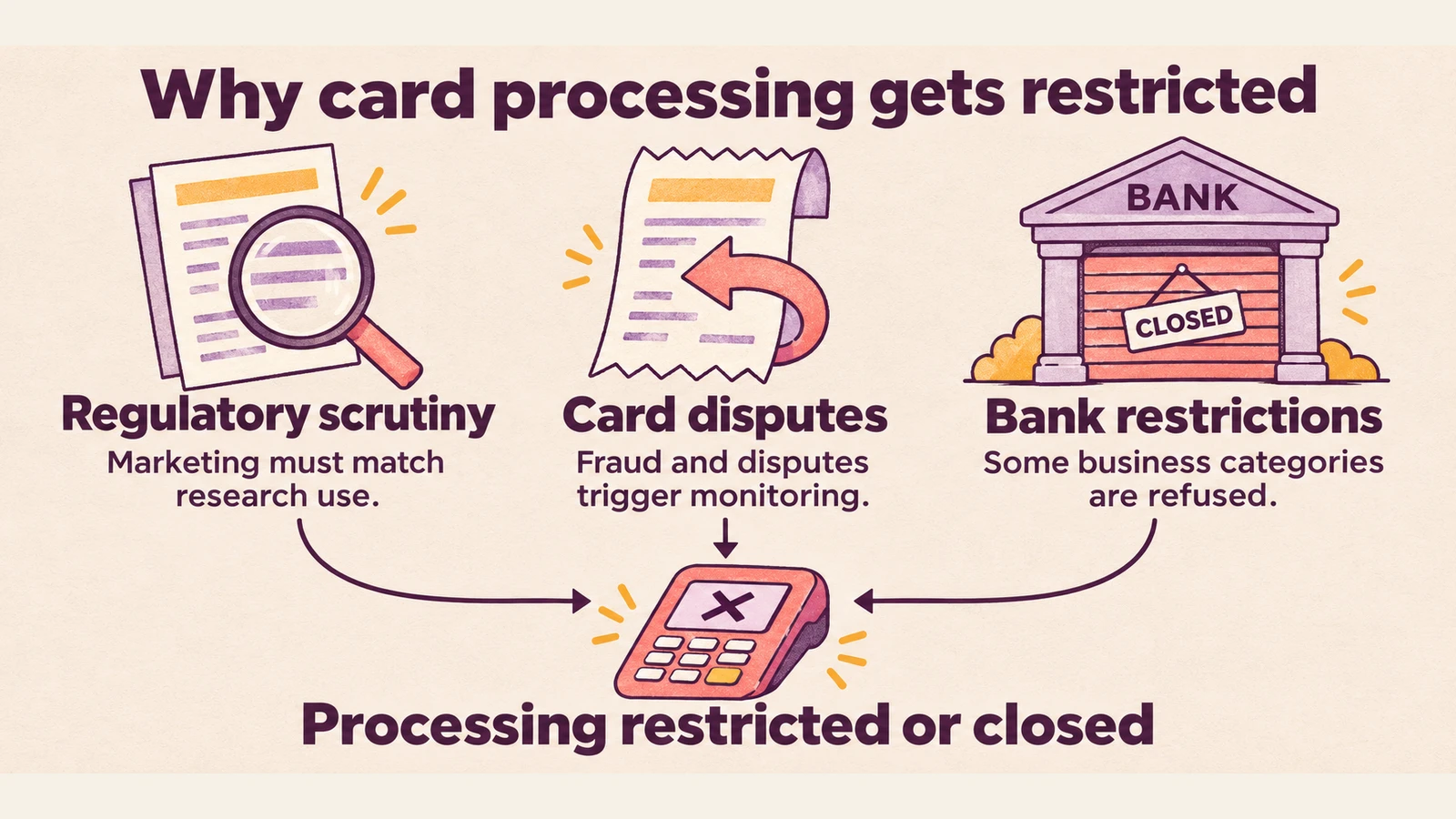
A card processor is liable for the merchants it signs, so it bans categories where one bad merchant can cost more than all good merchants earn. Peptides hit three triggers at once: the FDA treats many online peptide sales as unapproved drug sales, card networks fine high-dispute merchants, and the partner banks behind processors set their own category limits.
| Risk | Who sets the rule | What it means for a peptide supplier |
|---|---|---|
| Regulatory action | FDA | Warning letters when marketing points to human use |
| Dispute monitoring | Visa and Mastercard | Program fees and remediation once fraud and disputes cross a threshold |
| Restricted categories | Processors and banks | Category bans or extra review, often with little notice |
| Funds at risk | The processor | Reserves or held settlements while the processor covers its exposure |
Stripe's restricted businesses list is a typical example. It prohibits mislabeled research chemicals and places prescription products under extra review, and it says these rules come from the financial laws and the card network and bank partners Stripe must follow.
What does the FDA say about "research use only" peptides?
The FDA looks at how a product is sold, not only at its label. When a seller's website, product names or bundled supplies point to human use, the agency treats a "research use only" peptide as an unapproved drug. That puts the merchant's business at risk, and processors avoid merchants they expect to lose.
The FDA posted warning letters to at least seven online sellers with "peptide" in their name between December 2024 and August 2026, to Summit Research Peptides (December 2024), USApeptide (February 2025), Gram Peptides (March 2026), Wholesale Peptide (June 2026), and on 24 August 2026 to Peptide Partners, Peak Performance Peptides and Royal Peptides. In one of them, the FDA wrote:
"evidence obtained from your website establishes that your products are intended to be drugs for human use."
For a processor, every letter is a signal that the whole category draws enforcement. For a lawful research supplier, the lesson is direct: the label does not protect a business whose marketing says otherwise.
How do card network rules raise the risk?
Card networks measure every merchant's fraud and dispute rate each month and charge the processor when a merchant runs too high. A category with frequent buyer disputes pushes merchants toward those limits, and the processor pays first.
Visa describes its monitoring program plainly:
"Each month, Visa monitors fraud, dispute, and enumeration levels and identifies acquirers or merchants that exceed monthly VAMP thresholds."
According to the same fact sheet, the "excessive merchant" threshold in the US, EU, Canada and Asia Pacific dropped from 2.2% to 1.5% on 1 April 2026, for merchants with at least 1,500 fraud reports and disputes in a month. Disputes count toward that ratio even when the order shipped as described, unless they are resolved through a pre-dispute solution first.
What happens when a processor drops a peptide supplier?
The account closes, often with little notice, and processor agreements usually allow settled funds to be held while the processor covers its own dispute exposure. The supplier then has to rebuild checkout on a new provider while orders wait, which costs both revenue and buyer trust.
Most suppliers then move to a high-risk merchant account. Those accounts accept the category, but they usually come with higher rates, a rolling reserve that holds part of each sale for months, and the same dispute monitoring that caused the first closure. Card payments with a standard processor cost 2.9% plus 30 cents on Stripe's published pricing, and high-risk accounts sit above that.
What payment options remain for research peptide suppliers?
Suppliers that lose card processing usually choose from four options, and each trades cost, speed and dispute exposure differently. The right mix depends on whether your buyers are institutions that pay invoices or individual researchers who expect to pay at checkout.
- High-risk merchant account. Accepts cards, but adds higher rates, rolling reserves and card-network dispute monitoring.
- Bank transfers and invoices. Fit institutional buyers, but settle slowly and need manual reconciliation.
- Peer-to-peer payment apps. Easy for buyers, but personal accounts are not built for business sales, and they can close the same way.
- Bitcoin and stablecoins over Lightning. Lightning is Bitcoin's payment layer that settles in seconds. Payments go straight to the merchant's own wallet, and a completed payment cannot be reversed through a card chargeback.
Does accepting Bitcoin or stablecoins make a peptide business compliant?
No. A payment method changes how money moves, not whether a product is lawful. A supplier still needs to sell only for lawful research use, keep its marketing consistent with that, and follow the law where it operates and where its buyers are located. Any payment provider that suggests otherwise is a risk in itself.
What Lightning does change is the payment side of the risk. Payments settle in seconds, they cannot be reversed through a card chargeback, and the funds sit in a wallet you control rather than in a processor's account. Refunds become separate payments that you send under your own refund policy.
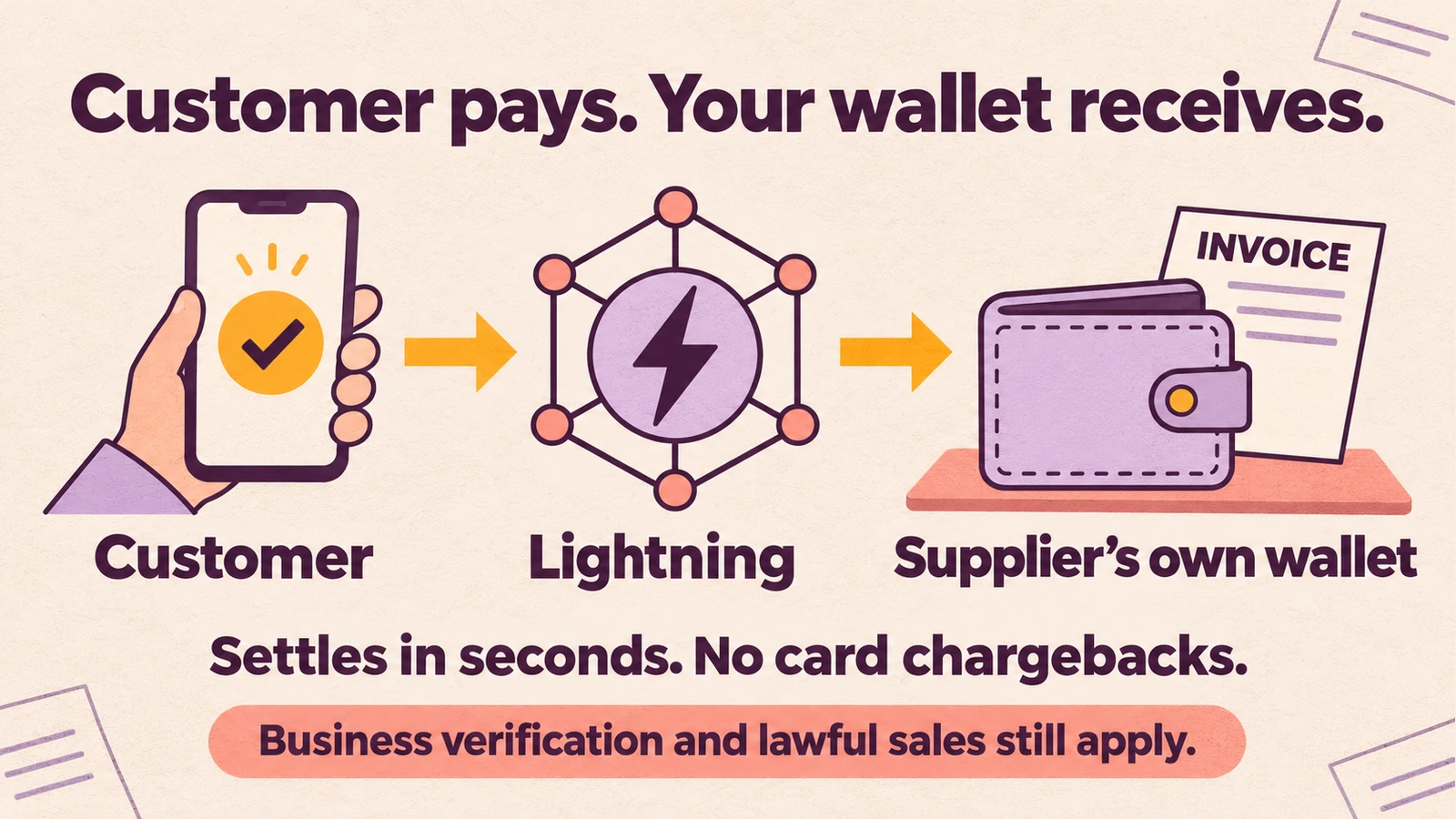
With Amboss Payments, research suppliers accept Bitcoin and stablecoin payments over Lightning through one API, with funds settling to their own wallet. It does not make an unlawful product lawful: Amboss verifies every business, and peptide suppliers go through manual review before live payments. You can start now with a free sandbox, see how Amboss Payments works for research peptide suppliers, or talk to our team about your setup.
Frequently asked questions
Do payment processors allow research peptides?
Many mainstream processors restrict them. Stripe prohibits mislabeled research chemicals and puts prescription products under extra review, and many other processors follow similar rules from their partner banks. Some high-risk processors accept the category, usually with higher rates, rolling reserves and close monitoring of disputes. Check the written policy before you sign, not only the sales call.
Why was my peptide merchant account closed without warning?
Processors usually close accounts after an internal review finds a restricted category, a rising dispute ratio or a regulatory signal such as an FDA warning letter in the category. Their agreements let them close accounts and hold funds to cover future disputes. Ask the processor in writing for the reason and for the release date of any held funds.
Is "research use only" labeling enough for payment processors?
No. Processors and the FDA look at the whole business, including product pages, names, bundled supplies and marketing claims. If those point to human use, the label does not change the assessment. A lawful research supplier keeps every part of its marketing consistent with research use and sells to research buyers.
Can a peptide supplier accept Bitcoin or stablecoin payments?
Yes, if the business is lawful where it operates and where its buyers are located. Bitcoin and stablecoin payments over Lightning settle in seconds and go to the supplier's own wallet. Providers still verify the business: with Amboss Payments, peptide suppliers go through business verification and manual review before live payments.