
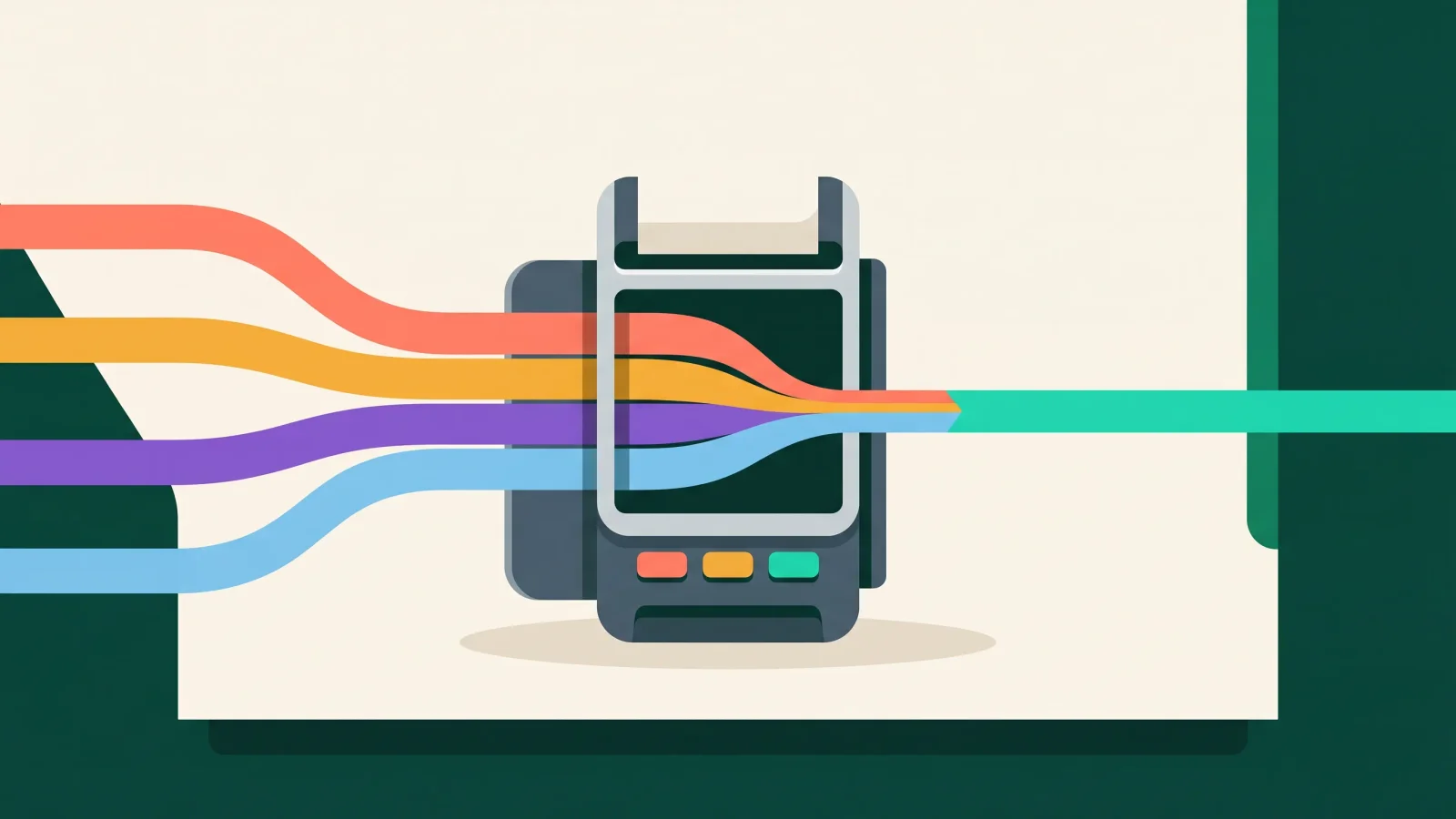
Lightning, Bitcoin's payment layer, lets a customer pay in one currency while you receive another. Someone can send a dollar stablecoin and you can settle in bitcoin, or the reverse, without either side holding the same asset. For a business, that means the currency a customer chooses stops being your problem to manage.
Picture a cashier asking whether you will pay in cash, card, or one of a hundred dollar-pegged stablecoins with near-identical tickers. On Lightning that question mostly disappears. The network handles the movement and conversion, so you accept what the customer sends and keep the form you want.
What does handling multiple currencies mean for a business?
It means you stop carrying the fragmentation that makes multi-currency acceptance expensive. The stablecoin market alone has splintered into dozens of dollar tokens across many blockchains, and USDT on-chain volume topped $10 trillion in 2024, closing in on Visa's roughly $16 trillion annual volume. Accepting all of that the traditional way means one integration per token per chain, each with its own custody and support burden.
A settlement layer that routes value in bitcoin and converts at the edges collapses that work. You accept the currency your customer sends without running a wallet for every asset, because the network and the edge nodes carry the conversion. The same infrastructure that accepts bitcoin is designed to add stablecoins without new rails, because Taproot Assets payments route over the existing network with no node upgrade or opt-in. Payments settle in under a second, and cross-currency delivery no longer depends on which chain a token happens to live on.
This currency-agnostic design is what makes bitcoin and stablecoin acceptance practical to run. Amboss Payments processes both bitcoin and USDT or USDC payments over Lightning on a single integration, so you accept whichever asset a customer sends and settle in the form you want. You do not run per-chain custody or pick which stablecoin network to support. The conversion work happens inside the rail, not in your checkout. If your customers pay in mixed currencies today, that fragmentation is exactly the cost this model removes, and you can compare it against card and gateway pricing in our breakdown of crypto payment gateway fees.
The rest of this piece covers how Lightning actually moves that value, which is worth understanding before you rely on it.
Does the Lightning Network have its own currency?
Lightning is denominated in bitcoin by default, but a channel can also hold an asset. A Lightning channel (a two-party payment balance held open between wallets) records how much bitcoin, or how much of a Taproot Asset like a stablecoin, sits on each side. Bitcoin is still the routing backbone: the public hops in the middle of the network forward bitcoin, and every other currency is expressed in terms of it.
| What you hold | What the merchant receives | How it travels on Lightning | Where conversion happens |
|---|---|---|---|
| Bitcoin | Bitcoin | Sent directly as bitcoin | No conversion needed |
| A stablecoin (USDT, USDC) | The same stablecoin | Rides on Taproot Assets channels | Edge nodes swap to bitcoin and back |
| One currency, say US dollars | A different one, say euros or bitcoin | Converted to bitcoin, routed, converted at the far end | An edge node at each end |
Bitcoin works well as the transport asset because the liquidity is already there. At the July 2024 launch of multi-asset Lightning, Lightning Labs described bitcoin as a global routing currency backed by the 5,400 bitcoin then allocated to the network. You can check the current public capacity on the live Lightning Network capacity tracker. New assets do not have to bootstrap their own routing network; they borrow bitcoin's.
How does Lightning handle payments in stablecoins and other currencies?
Non-bitcoin currencies reach Lightning through Taproot Assets, a protocol from Lightning Labs that lets assets like stablecoins be issued on bitcoin and moved over the same channels. It went live as the first multi-asset Lightning protocol on mainnet with the Taproot Assets v0.6 release on 24 June 2025, and stablecoins like USDT and USDC are the assets in most demand for it.
The conversion happens at what Lightning calls an edge node: a node that accepts a stablecoin from the customer, quotes a rate up front, and forwards the value as an ordinary bitcoin payment. The official Taproot Assets edge node documentation is explicit that this is non-custodial, so the node swaps the asset to bitcoin without ever holding customer funds. Lightning Labs frames the network of edge nodes this way:
These edge nodes provide a critical service by converting assets to and from bitcoin at the edges of the network, enabling Taproot Assets on Lightning to act as a decentralized foreign exchange network.
For a business, the practical part is that the rate is locked before the payment goes through, and the rest of the network only ever moves bitcoin. That is why a stablecoin payment can travel over channels opened years before stablecoins existed, with no upgrade required from anyone in the middle.
Can you send one currency and receive another over Lightning?
Yes. The sender's asset and the recipient's asset do not have to match. A sender can hold a US dollar stablecoin, the recipient can want euros or plain bitcoin, and each edge node converts at its own end. The Taproot Assets v0.6 release added reliability for exactly this: a receiver can combine up to 20 incoming asset channels from different edge nodes to make cross-currency payments land.
The reason this works is that only the two ends care about the currency. River Financial puts the routing side plainly:
For any routing nodes in between, the transfer would look like any lightning transfer as they would be moving bitcoin.
So a payment can start as one stablecoin and finish as another, or as bitcoin, while every node in the middle just forwards bitcoin. The Taproot Assets documentation walks through an example where edge nodes swap between a USD asset and bitcoin, so the recipient can opt to receive bitcoin or the asset of their choice. The currency you send is not the currency that arrives; bitcoin carried the value in between.
Frequently asked questions
Does Lightning support stablecoins like USDT and USDC?
Yes, through the Taproot Assets protocol, which lets stablecoins be issued on bitcoin and moved over Lightning channels. The v0.6 release on 24 June 2025 was the first multi-asset Lightning protocol live on mainnet. USDT, USDC, and other assets can use the same mechanism.
How does Lightning convert one currency to another?
Conversion happens at edge nodes, not in the middle of the network. An edge node holds a stablecoin or asset channel with its client and bitcoin channels with the rest of Lightning. It quotes a rate, accepts the client's asset, and forwards bitcoin. A second edge node converts back to the recipient's chosen currency. The core of the network only ever forwards bitcoin.
Can I send dollars and have someone receive a different currency?
Yes. Because value moves as bitcoin between two conversion points, the sender's currency and the recipient's currency can differ. You might pay with a US dollar stablecoin while the recipient receives euros or bitcoin. An edge node converts at each end, and every routing node in between only forwards bitcoin, so the two sides never need to hold the same asset.
Does the middle of the Lightning Network need to understand stablecoins?
No. Routing nodes forward bitcoin payments and do not need to know Taproot Assets exists. Only edge nodes handle the asset-to-bitcoin swaps, and they do so without custody of client funds. This is why stablecoin payments can travel over channels opened long before stablecoins were added to the network.
Is currency conversion on Lightning free?
No, but it is cheap relative to traditional cross-border options. Edge nodes charge a spread or fee for each asset-to-bitcoin swap, agreed in advance through a Request for Quote step. The Lightning transport itself sends value instantly and for low fees, so the conversion spread, not the network transport, is usually the main cost.