
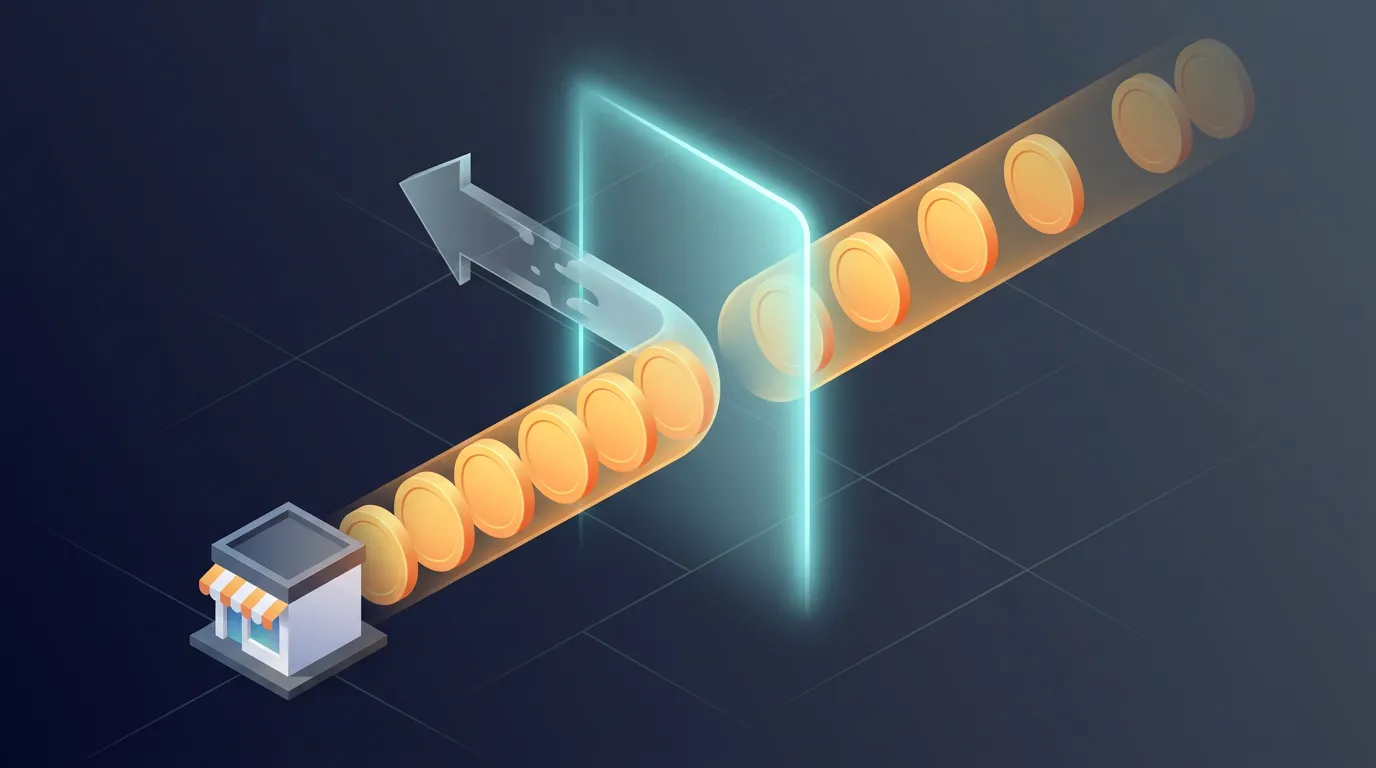
Chargebacks are the cost most merchants accept as the price of taking cards. They are also the cost that compounds the fastest. Every disputed transaction costs $15 to $25 in fees on top of the lost goods, and high chargeback ratios trigger penalty pricing or termination from your processor. For a business doing 5,000 transactions a month at a 1% chargeback rate, that is $750 to $1,250 per month in dispute fees alone, before any lost revenue.
This guide covers six strategies to reduce chargebacks on your existing card processing, and one structural option that removes them from your payment stack entirely. The first six are about prevention. The seventh is about architecture.
What a Chargeback Actually Is
A chargeback is a forced reversal of a card payment initiated by the cardholder's bank, not by the merchant. The cardholder disputes a charge, the issuing bank pulls the funds back from your acquirer, and you have a limited window (typically 7 to 14 days) to submit evidence that the transaction was legitimate.
Even if you win the dispute, the chargeback fee usually stays. If you lose, you also lose the underlying transaction value. If your chargeback rate exceeds 1% of volume (the standard threshold), Visa and Mastercard move you into monitoring programs with escalating fines and stricter rules.
The cardholder has three categories of reasons they can file: true fraud (someone used their card without permission), merchant fault (item not received, item not as described, refund not processed), and friendly fraud (the cardholder bought the thing, then disputed it anyway). All three cost you the same.
Six Strategies to Reduce Chargebacks on Card Payments
1. Use clear and recognizable billing descriptors
The most common cause of friendly fraud is the cardholder not recognizing the charge on their statement. A descriptor like "ACME_INC_CHK_8829" does not tell a customer what they bought. "MyStoreName: Order #1234, [email protected]" tells them everything they need to recognize the charge and contact you instead of their bank.
Configure your descriptor through your processor's dashboard. Include your business name, what they bought if possible, and a contact method. Businesses that update descriptors typically see 10 to 30% fewer "I don't recognize this" disputes within 30 days.
2. Run fraud filters on every transaction
Stripe Radar, Signifyd, Riskified, and similar fraud-scoring services run every transaction against patterns of known-fraud behavior. They block, challenge, or allow based on a risk score you can tune to your tolerance.
For most online businesses, fraud filters reduce true-fraud chargebacks by 50 to 70%. The trade-off is false-positives: legitimate orders flagged and lost. The right configuration depends on your average order value and margins. High-margin businesses can afford to be stricter. Low-margin businesses need to accept a slightly higher fraud rate to avoid losing good orders.
3. Require 3D Secure on risky transactions
3D Secure (3DS) shifts the fraud liability from the merchant to the card issuer. When a customer authenticates through their bank during checkout (typically via SMS code or app push), the issuing bank takes responsibility for fraud-related chargebacks on that transaction.
3DS used to add friction that killed conversion. The current version (3DS 2.0) is far more transparent for most customers, often passing through silently. The best practice is conditional 3DS: route only high-risk transactions through authentication, based on amount, geography, or fraud-score thresholds.
4. Build a dispute representment process
Even with prevention, disputes happen. Your representment process determines whether you win or lose them. A good process includes automated collection of transaction evidence (timestamps, IPs, shipping confirmations, customer communications), a template library for common dispute types, a representment service or in-house specialist for complex cases, and documentation that the goods or services were delivered.
Win rates on represented disputes vary widely. Businesses with a serious process win 30 to 50% of cases. Businesses that don't represent at all win 0%.
5. Layer in identity and address verification
For higher-value transactions, add identity verification: Address Verification Service (AVS) for card-billing-address mismatches, ID verification through services like Persona or Onfido, and customer-account-age signals.
These add friction to checkout, which costs conversion. They are best used selectively: on first-time customers, on high-value orders, on customers from high-fraud geographies.
6. Document delivery, especially for digital goods
For physical goods, signed delivery confirmation is the gold standard for winning "item not received" disputes. For digital goods, capture and store download timestamps, IP addresses, account login events, and any product usage logs that prove the customer received and used what they paid for.
For subscription businesses, store cancellation interactions and proof of email delivery for renewal notices. "I didn't know I would be charged" is one of the most common dispute reasons.
The Structural Alternative: Payment Rails Without Chargebacks
Every strategy above reduces chargeback frequency. None of them eliminates the structural possibility, because card networks were designed with reversibility built in. The cardholder has the right to dispute a charge. The merchant has the obligation to defend it.
A different category of payment rails removes the structural possibility entirely.
Bitcoin and stablecoin payments through Amboss settle on the bitcoin payment network. When a payment confirms, it is final. There is no dispute window. There is no card-issuer reversal. The funds are yours from the moment the transaction settles, and they cannot be pulled back.
This is not a fraud reduction. It is a structural feature of the payment rail. The cardholder's bank is not involved, because there is no card and no cardholder bank. The customer pays you directly, the payment is irreversible from confirmation, and the entire dispute infrastructure that surrounds card processing does not apply.
For businesses with chronic chargeback problems (digital goods, subscriptions, gaming, high-risk verticals), this is the difference between a 1% loss line and a 0% loss line.
Trade-Offs of Moving to Non-Reversible Rails
Moving payment volume onto irreversible rails removes chargebacks. It also removes the customer protections that chargebacks provide.
You take on more responsibility for customer trust:
- Your refund policy becomes the only recourse for unsatisfied customers
- Customer service quality has to compensate for the absence of bank-mediated dispute resolution
- Reputation matters more, because customers know they cannot reverse the payment
You also shift your fraud profile:
- True-fraud chargebacks (stolen cards) disappear because there are no stolen cards
- Friendly fraud disappears because there is no chargeback mechanism
- Customer-initiated refund requests increase, because customers cannot escalate to their bank
For most businesses, the net is positive: customer service costs go up modestly, chargeback costs go down dramatically, and the dispute infrastructure overhead disappears. For consumer businesses where the chargeback right is part of the value proposition, the calculus is different.
Card-Based Prevention vs Structural Elimination
| Dimension | Card prevention strategies | Irreversible rails |
|---|---|---|
| Chargeback rate | Reduced 50-80% with effort | 0% structurally |
| Friendly fraud | Reduced, not eliminated | Not possible |
| Dispute fees | Still apply | None |
| Penalty pricing risk | Still applies if ratio creeps up | Not applicable |
| Customer protection | Preserved through bank dispute | Shifted to your refund policy |
| Settlement speed | T+1 to T+3 | Seconds |
| Implementation effort | Multiple tools, ongoing tuning | New rail integration |
Frequently Asked Questions
What is the average chargeback rate by industry?
Across industries, the average sits around 0.6% of transaction volume. Subscription businesses average closer to 1%. Digital goods and gaming run 1-2%. Adult content, online gambling, and crypto-adjacent businesses often run 2% or higher, and many card processors will not service them at all.
Can you charge back a stablecoin payment?
No. Stablecoin payments settled on irreversible rails like the bitcoin payment network do not have a dispute mechanism comparable to card chargebacks. Once confirmed, the payment is final. Refunds are at the merchant's discretion through a separate transaction.
Do all chargebacks have fees?
In US card processing, almost always yes. Standard processors charge $15-$25 per chargeback initiated, regardless of whether you win or lose. Some processors waive fees on disputes you win, but this is the exception. The fee covers the operational cost of the dispute.
What chargeback rate triggers processor monitoring?
Visa places merchants in the Dispute Monitoring Program at 0.65% of transactions or 75 disputes per month (whichever comes first), and into the High-Risk program at 1.0%. Mastercard's Excessive Chargeback Program kicks in at 1.0%. Both come with escalating fines and stricter requirements.
Is moving to irreversible rails appropriate for consumer businesses?
It depends on the customer trust profile. For B2B, high-trust consumer brands, and digital goods, the loss of chargebacks rarely affects buying behavior. For low-trust consumer purchases or first-time customer transactions, the chargeback right may be part of why customers feel safe paying. Hybrid approaches (cards for new customers, irreversible rails for repeat customers or specific product lines) work for many businesses.
Start Eliminating Chargebacks From Your Payment Stack
The six prevention strategies above can cut your chargeback rate by 50 to 80% with consistent effort. The seventh changes the question entirely by removing chargebacks as a possibility, not a risk to be managed.
If you process payments globally and want to add a payment rail with no chargeback exposure, explore the Amboss Payments API to see how Bitcoin and stablecoin processing works for your business.