
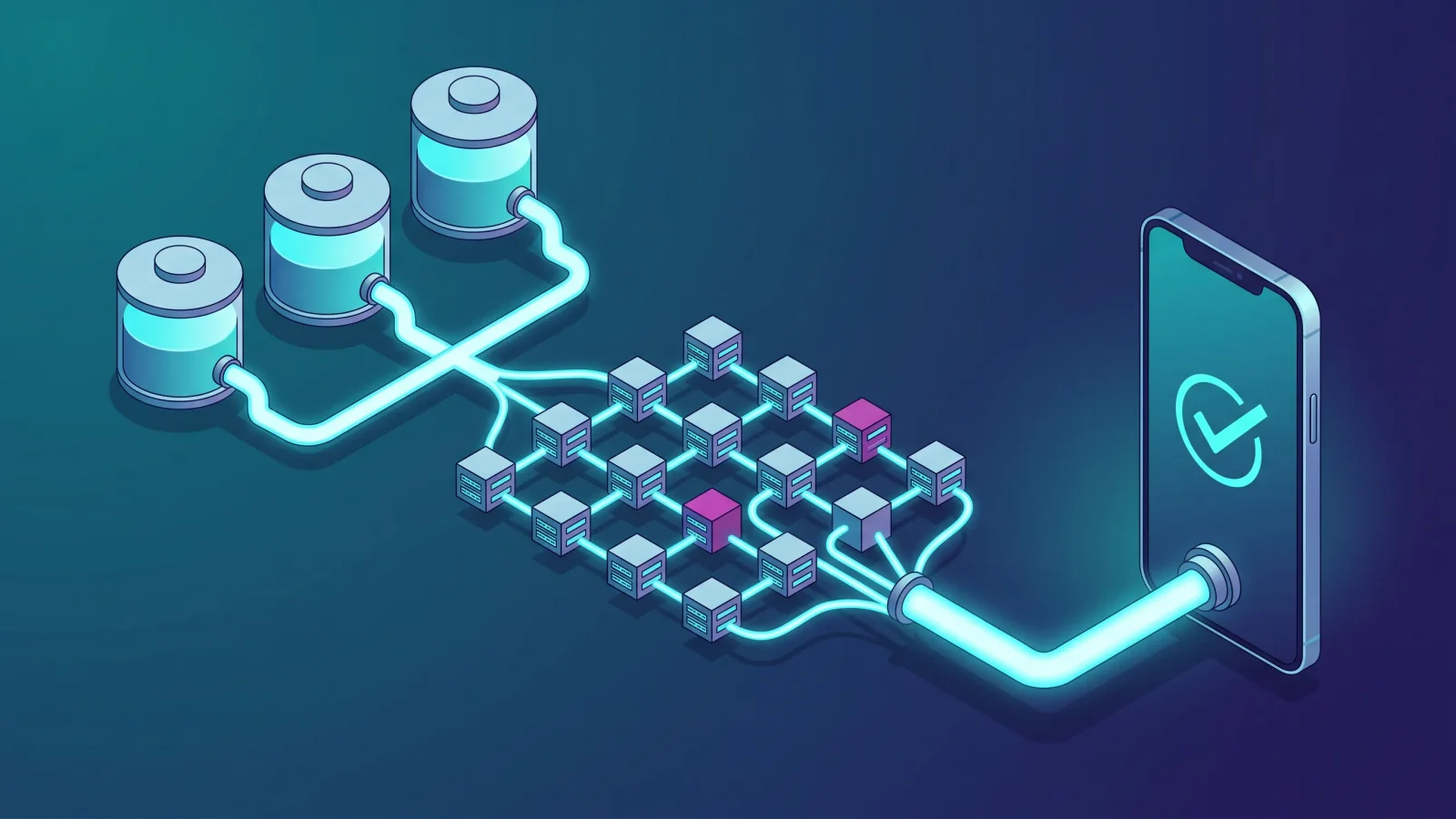
iGaming operators keep players by paying out instantly, and Lightning (Bitcoin's instant payment layer) settles a withdrawal in under a second for a fraction of a cent, with no chargebacks. Running Lightning well is the hard part: it takes constant liquidity management, reliable routing, and sanctions screening. A provider like Amboss handles all three, so you plug into one rail instead of building it.
See a payout settle in real time on Amboss for iGaming.
Why do iGaming players expect instant crypto payouts?
Because withdrawal speed now decides where players stay. When one site returns winnings in seconds and another takes three to five business days on card rails, the slower site loses players. Fast payouts have shifted from a perk to the baseline expectation, and crypto rails are the only ones that meet it at scale.
The gap between the rails is large.
| Payout method | Typical settlement | Cost per payout | Chargeback risk |
|---|---|---|---|
| Card refund / payout | 3 to 5 business days | Percentage of amount | Yes, reversible |
| On-chain Bitcoin | 10 to 60 minutes | Dollars during congestion | No |
| Lightning | Under one second | Fraction of one cent | No, final by protocol |
Cards also carry a cost operators cannot negotiate away. Stripe's public rate is 2.9% plus $0.30 per online card transaction before any high-risk iGaming surcharge. As Visa documents in its fee guidance:
Merchants negotiate and pay a "merchant discount" to their financial institution that is typically calculated as a percentage per transaction.
What makes Lightning hard for iGaming operators to run themselves?
The rail is fast, but keeping it fast is real work. Most guides sell the speed and skip the operations. Three things sit between an operator and reliable instant payouts, and all three take dedicated effort to run in-house:
- Liquidity, on both sides. To pay players out you lock up your own capital. To take deposits you pay someone else to make room for them. Both need constant funding and rebalancing, or payments start to fail.
- Reliability. A payout only lands if there is enough liquidity along the route. When it runs dry, withdrawals stall at the worst moment, on a big win during a busy night. That is the most common Lightning complaint.
- Compliance. Payments are instant and final, so you have to screen the counterparty for sanctions before the money leaves, not after.
Running all of this yourself means a node, an engineering team, and roughly $2,000 to $5,000 per month in infrastructure before anyone plays a hand. That is the real work behind Lightning Network payouts for iGaming, and it is the part a provider should carry for you.
How does Amboss handle Lightning payouts for iGaming operators?
Amboss runs the three hard parts so the operator does not have to. Amboss Payments is the rail: accept and pay out bitcoin and stablecoins over Lightning through one integration. Behind it, Magma is a liquidity marketplace that sources the capacity your deposits and payouts need on demand, priced by a competitive market instead of your own locked-up treasury. Reflex screens incoming and outgoing payments against sanctions lists at the moment they settle.
The point is that reliable payouts depend on a funded liquidity layer, and that is exactly what Amboss operates. The company is cited as the Lightning analytics authority on this trend, having summarized it plainly in a 2025 report:
It is not just one company that is putting more Bitcoin into the Lightning Network. It is across the board.
Live network capacity, node, and channel data sit on the Amboss Lightning explorer, the depth that lets payouts route reliably at scale.
Can iGaming operators pay players in stablecoins over Lightning?
Yes. Players who want speed without price swings can be paid in a dollar-pegged stablecoin that still settles over Lightning in under a second. Tether's USDT is the largest dollar stablecoin in circulation, with issuance detailed in Tether's transparency reporting, and Circle publishes the framework behind USDC in its transparency disclosures. One Lightning rail then serves both bitcoin-native and dollar-native players, with no separate multi-chain integration to maintain.
Getting started with instant payouts
If instant player payouts and lower fees are the goal, the shortest path is a provider that already runs the liquidity and compliance work. Amboss Payments gives you the Lightning rail, Magma keeps it funded, and Reflex keeps it compliant, so you launch instant deposits and withdrawals without building any of it. For the full cost picture against cards, see the cost and compliance comparison for iGaming crypto payments.
Frequently asked questions
How fast are Lightning Network payouts for iGaming players?
A Lightning payout settles in under a second when there is enough liquidity along the route. Speed is not automatic: it depends on funded, well-connected channels. A provider that sources liquidity through a marketplace like Magma keeps payout success high even during peak withdrawal demand, which is when in-house setups tend to slow down.
Do iGaming operators need to run their own Lightning node?
No. Running a node costs an estimated $2,000 to $5,000 per month plus continuous liquidity and channel management. A managed provider handles the node, routing, and rebalancing behind one integration for a sub-1% per-transaction fee. Self-hosting only makes sense for large operators with dedicated engineering teams who want full custody control.
Are Lightning payouts reversible if a player disputes a withdrawal?
No. Lightning payments are final by protocol, which is why they carry no chargebacks and need no rolling reserve. Operators handle disputes out of band, the same way they would for a bank transfer: investigation, KYC review, and a new payment if a refund is warranted. Screening at payout time, through a layer like Reflex, keeps operators compliant on an irreversible rail.
Can operators pay players in stablecoins instead of bitcoin?
Yes. Stablecoins route over Lightning alongside bitcoin, so operators can pay players in a dollar-pegged asset that still settles in under a second. This removes the price-volatility concern for players who want a stable balance, while the operator keeps a single Lightning rail for every payout.