
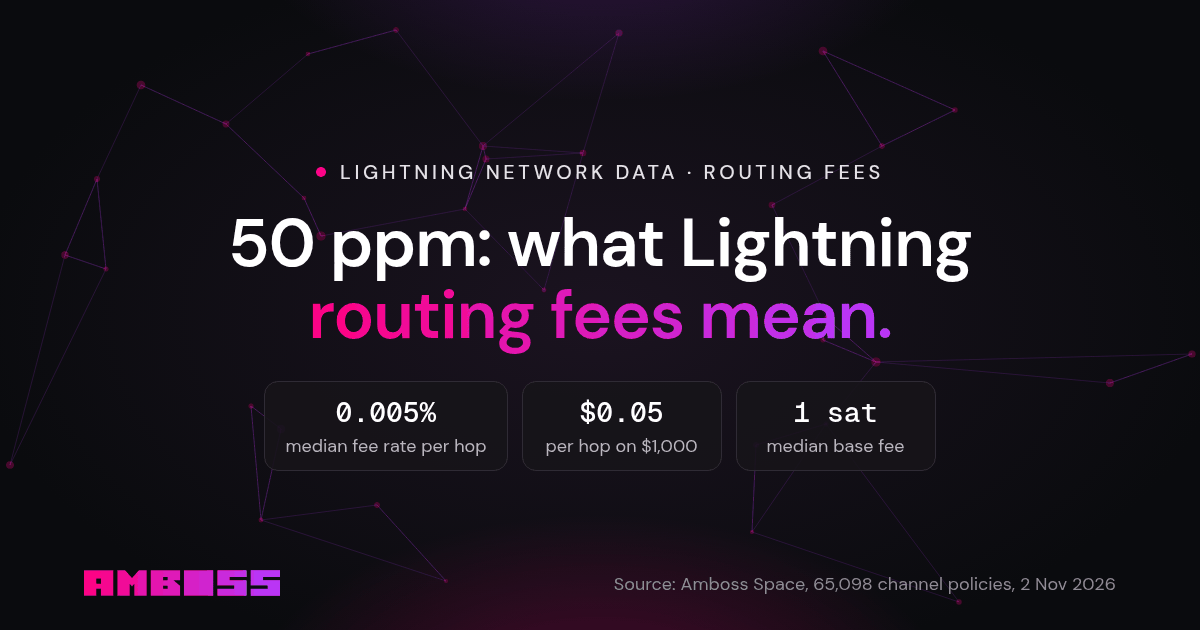
The median fee rate across public Lightning channel policies is 50 parts per million (ppm), or 0.005% of the amount forwarded. The median base fee is 1 sat. In the hourly snapshot of 2 November 2026, those medians were calculated across 65,098 channel fee policies.
This post explains how those fees work, what they mean in dollars, who pays them, and how they relate to what a business pays for a payments service.
How Lightning routing fees work
A Lightning payment travels through one or more channels between the payer and the recipient. Each node that forwards the payment can charge a fee, which it sets in its channel policy. The policy has two parts:
- A fee rate, expressed in parts per million of the amount forwarded. 50 ppm means 50 units of fee for every 1,000,000 units forwarded, which is 0.005%.
- A base fee, a fixed amount per forwarded payment, expressed in sats or thousandths of a sat.
The fee for one hop is the base fee plus the fee rate multiplied by the amount. A payment that crosses several hops pays each forwarding node along the way.
What 50 ppm means in dollars
At the median fee rate, each hop costs:
| Payment amount | Fee rate part per hop (50 ppm) |
|---|---|
| $100 | $0.005 |
| $1,000 | $0.05 |
| $10,000 | $0.50 |
| $100,000 | $5.00 |
The median base fee of 1 sat was worth about $0.0008 on 1 November 2026, based on the bitcoin price implied by Amboss Space data that day. Real routes vary. Some hops charge more than the median, some charge less, and the number of hops depends on where the payer and recipient sit in the network.
A stable median
The median fee rate has been steady. In every hourly snapshot from November 2025 to 2 November 2026, it sat between 50 and 71 ppm. In four of the twelve full months shown below it never left 50 ppm.
| Month | Lowest hourly median (ppm) | Highest hourly median (ppm) |
|---|---|---|
| Nov 2025 | 50 | 50 |
| Dec 2025 | 50 | 68 |
| Jan 2026 | 50 | 67 |
| Feb 2026 | 50 | 53 |
| Mar 2026 | 50 | 50 |
| Apr 2026 | 50 | 50 |
| May 2026 | 50 | 55 |
| Jun 2026 | 50 | 70 |
| Jul 2026 | 50 | 64 |
| Aug 2026 | 50 | 71 |
| Sep 2026 | 50 | 50 |
| Oct 2026 | 50 | 55 |
Why the median, not the average
A small number of channels set very high fee rates. Those outliers pull the mean far above what a typical route charges: in the same 2 November snapshot the mean fee rate was more than 3.7 million ppm, while the median was 50 ppm. The median describes the typical channel; the mean does not.
Who pays routing fees
On Lightning, the sender pays routing fees. When a business issues a fixed-amount invoice through Amboss Payments, the payer covers routing and conversion fees, and the business receives the invoiced amount.
Network fees are not a service price
The network fee rate is what independent routing nodes charge to forward a payment. It is not what a business pays for a payments service.
Amboss Payments is a managed service. It covers the infrastructure, liquidity and operations behind accepting and sending payments, so your team does not run nodes or manage channels. It costs $49.99 a month plus 2% of payment volume, with no setup fee, and that is not the network fee rate. Talk to our team about volume-based discounts for high volume.
If you know what card processing costs your business today, the calculator on our iGaming page lets you enter your own figures for monthly volume, processing fee and chargeback rate. The result reflects the numbers you enter; it is not an Amboss price.
On-chain fees
Lightning channels are opened and closed on the Bitcoin blockchain, so on-chain fees matter to node operators. On 2 November 2026, the Amboss Space mempool endpoint estimated 2 sat/vB for the fastest confirmation and 1 sat/vB for confirmation within an hour. A payment inside an open channel does not pay an on-chain fee.
Method and sources
- Median fee rate, mean fee rate, policy count and median base fee: Amboss Space hourly network snapshot (
getNetworkMetrics.historical_snapshots), 2 November 2026, 14:00 UTC. The API reports the base fee in millisatoshis (1,000 msat = 1 sat). - Monthly range: Amboss Space hourly fee-rate median series (
historical_series), 1 November 2025 to 2 November 2026. - Bitcoin price used for the sat conversion: Amboss Space daily series, USD capacity divided by BTC capacity on 1 November 2026 (about $77,682 per BTC).
- On-chain fees: Amboss Space
getMempoolFees, fetched 2 November 2026. - Live data: amboss.space/stats.