
Abstract
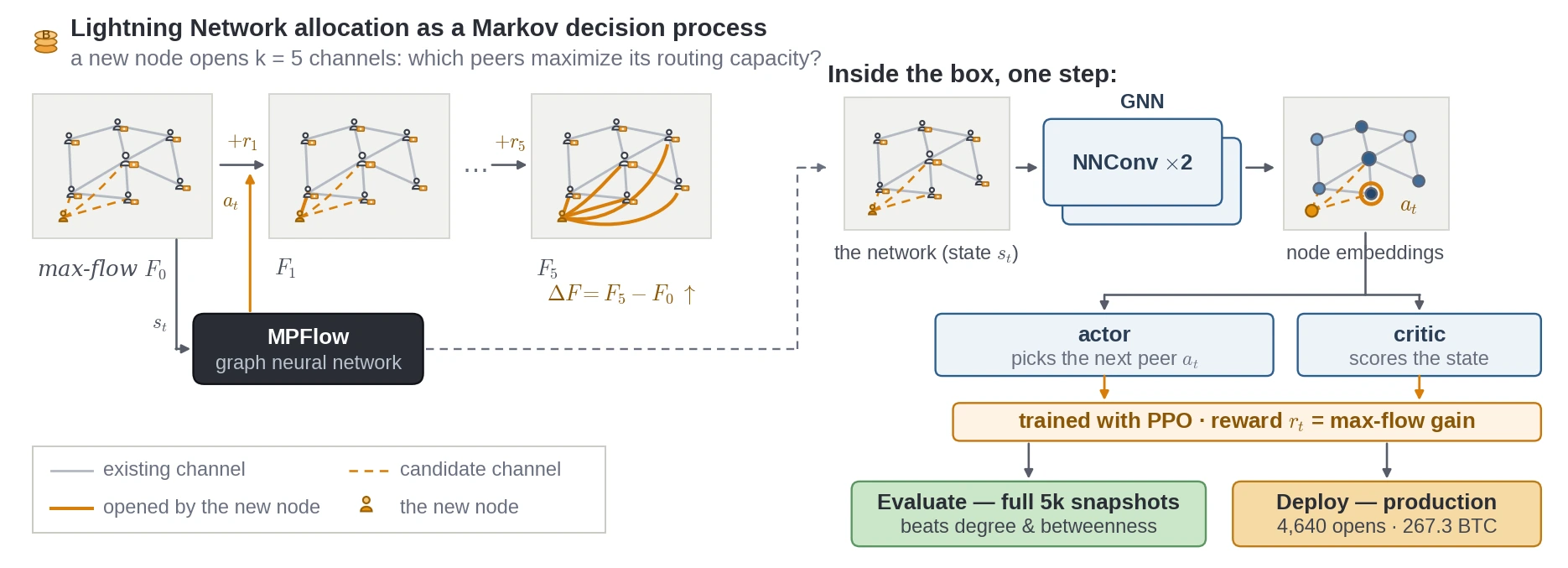
We address liquidity placement in the Bitcoin Lightning Network (LN): given a fixed budget, which channels should a node open to maximize its routing capacity? We cast this as a budget-constrained combinatorial optimization problem on graphs, selecting k edge additions that maximize s–t max-flow, a theory-grounded measure of routing capacity, and solve it with graph reinforcement learning.
Our lightweight agent combines a message-passing policy network with proximal policy optimization (PPO) and action masking, and is trained under a hub-exclusion curriculum: the network's top hubs are removed from training subgraphs, forcing the policy to learn capacity-aware placement rather than hub attachment.
In extensive experiments on real Lightning Network snapshots, our method consistently outperforms strong heuristic baselines on the max-flow objective across multiple seeds and unseen graphs. The agent has been deployed in production for peer recommendations, executing 4640 channel-open decisions that cumulatively allocate 267.3 BTC over $16 million across 30 managed nodes.
Read the full paper on arXiv.