


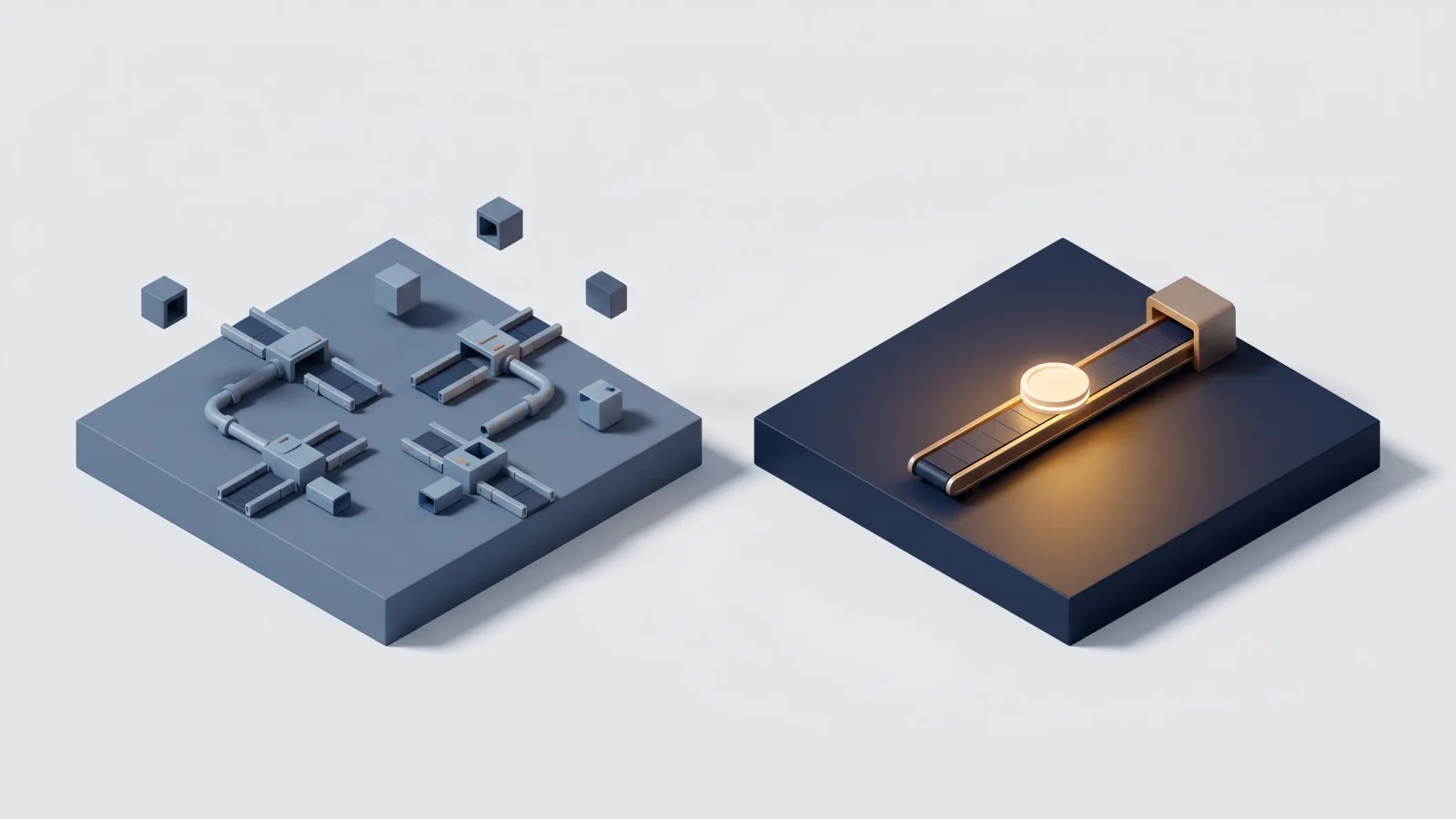
RGB and Taproot Assets are both Bitcoin protocols that issue assets like stablecoins using client-side validation, where transaction data stays off-chain rather than on a public ledger. The practical gap is maturity. Taproot Assets, built by Lightning Labs, is live on Bitcoin mainnet and can move stablecoins over the Lightning Network, Bitcoin's instant low-fee payment layer. RGB offers richer smart contracts but far less production deployment.
What is the difference between RGB and Taproot Assets?
RGB and Taproot Assets both issue assets on Bitcoin using client-side validation, a model where ownership proofs live with the holder instead of on a public chain. RGB, started in 2016, aims at general smart contracts. Taproot Assets, built by Lightning Labs in 2022, focuses narrowly on moving tokens like stablecoins over the Lightning Network.
Both protocols launched within six years of each other, and a side-by-side comparison of the two protocols shows they share more than they differ. The split that matters for a payments business is scope and where each one runs in production.
| Dimension | RGB | Taproot Assets |
|---|---|---|
| First released | 2016, by Giacomo Zucco | 2022 as Taro, by Lightning Labs |
| Validation | Client-side, off-chain proofs | Client-side, off-chain proofs |
| Design | Broad, general smart contracts | Focused on moving assets |
| Lightning use | Early, limited live deployment | Live on Bitcoin mainnet today |
| Integration | More complex to build on | Simpler, asset-focused |
| Maintained by | LNP/BP Standards Association | Lightning Labs, maker of lnd |
The two protocols are close cousins. Bitcoin Optech's breakdown of client-side validation notes that Taproot Assets was heavily inspired by RGB, and that to an outside observer, transactions from either one look like ordinary Bitcoin transactions.
Which protocol works with the Lightning Network today?
Taproot Assets is live on the Lightning Network on Bitcoin mainnet today, and it can move stablecoins over that network. RGB is designed to work with Lightning, but its live deployment is still early. For a business that needs to move stablecoins now, that difference decides the question on its own.
The Taproot Assets v0.8 release notes describe the current state plainly:
Taproot Assets is the first multi-asset Lightning protocol on mainnet, where assets like stablecoins can be minted on bitcoin and sent over the Lightning Network instantly and for low fees.
The protocol is maintained by Lightning Labs, the same team behind lnd, the most widely deployed Lightning implementation. That matters for a build decision: the asset layer and the payment layer come from one well-funded source. The Taproot Assets v0.8 release notes also report a 7x speedup in proof verification, a sign of a protocol being hardened for production rather than designed on paper.
Lightning itself is not a small network. Public capacity and node counts are tracked live on the Lightning Network capacity tracker, and Taproot Assets rides that existing routing mesh instead of asking the ecosystem to bootstrap a separate one.
Why is Taproot Assets the better fit for a payments product?
Taproot Assets is the better fit for payments because it does one job and does it on infrastructure that already works. It moves tokens over the Lightning Network, reuses Bitcoin's Taproot privacy, and is maintained by Lightning Labs alongside lnd. RGB aims at general smart contracts, which adds complexity a payment rail does not need.
For a team shipping a product, the build experience sets the timeline. The Taproot Assets v0.8 release notes pair the protocol with a software development kit aimed at exactly that:
The combination of v0.8 and the Taproot Assets SDK is meant to make the first hour of building on Taproot Assets feel a lot more productive.
A narrow design is also a security advantage. Taproot Assets moves tokens and nothing else, so there is no general smart-contract engine to audit or exploit. RGB's broader programmability adds attack surface without giving a payments rail a reason to carry it. The simpler protocol is the one with fewer ways to fail when real money moves through it, and it is the one already running on Bitcoin mainnet.
Is Taproot Assets ready to move stablecoins in production?
Yes. Taproot Assets runs on Bitcoin mainnet, and Lightning Labs has shipped a series of production releases that let assets be minted on Bitcoin and moved over the Lightning Network. RGB can host assets too, but it carries far less live deployment, which makes it the higher-risk choice for a product shipping today.
The maturity signal is the release history, not a single launch. Lightning Labs moved Taproot Assets from the 2022 Taro proposal to a live mainnet protocol, then shipped the v0.6 release in June 2025 and v0.8 a year later, each focused on making stablecoin minting and transfer more reliable. RGB has been in development since 2016 without a comparable record of production releases on Lightning.
For a payments product, a protocol that ships on a schedule is worth more than a protocol with a larger feature set on paper. The question is not which design wins a whiteboard debate. It is which one can move money for your customers this year, and that is the one with a live mainnet and active releases behind it.
Which asset protocol should a payments business build on?
For moving stablecoins and bitcoin between businesses and customers, build on the protocol that is live on Lightning today. That is Taproot Assets. RGB may suit experimental projects that need general smart contracts and can wait on their Lightning deployment, but for a payments product that has to ship, Taproot Assets is the one that works in production now.
Amboss Payments is built on Taproot Assets and the Lightning Network, so businesses accept bitcoin and stablecoin payments on one rail that settles in seconds. If your product is comparing asset protocols because a competitor runs on RGB, the deciding question is not which design is more elegant. It is which one can move your customers' money this quarter. See how Amboss Payments works for payment providers to evaluate it against an RGB-based stack on the axes that affect your settlement and cost.
Frequently asked questions
Is RGB or Taproot Assets better for stablecoins?
Taproot Assets is the better choice for stablecoins today because it is live on Bitcoin mainnet and can mint and move stablecoins over the Lightning Network. RGB can technically host stablecoins, but it carries far less production deployment on Lightning, which makes it the higher-risk bet for a payments product right now.
Do RGB and Taproot Assets both use client-side validation?
Yes. Both protocols keep asset data off-chain and rely on client-side validation, where the holder carries the proof of ownership rather than recording it on a public ledger. Bitcoin Optech notes Taproot Assets was heavily inspired by RGB, and transactions from either protocol look like ordinary Bitcoin transactions to outside observers.
Is Taproot Assets live on the Lightning Network?
Yes. Taproot Assets runs on Bitcoin mainnet and is maintained by Lightning Labs, the team behind lnd, the most widely deployed Lightning implementation. It reached its v0.8 release in June 2026, and the protocol lets assets like stablecoins be minted on Bitcoin and sent over the Lightning Network instantly and at low cost. RGB is designed for Lightning too, but its live deployment is still early.
Is RGB more advanced than Taproot Assets?
RGB supports more general smart contracts, but that breadth is not an advantage for payments. Taproot Assets is deliberately focused on moving assets, which makes it simpler to integrate and harder to break in production. For issuing and moving stablecoins over Lightning, the focused protocol with a live mainnet deployment is the stronger choice for a payments business.
Can I accept stablecoin payments without choosing a protocol myself?
Yes. A payment processor handles the protocol layer for you. Amboss Payments runs on Taproot Assets and Lightning, so you accept bitcoin and stablecoin payments through one integration without building on RGB or Taproot Assets directly. The protocol choice is made and maintained by the processor rather than your engineering team.