
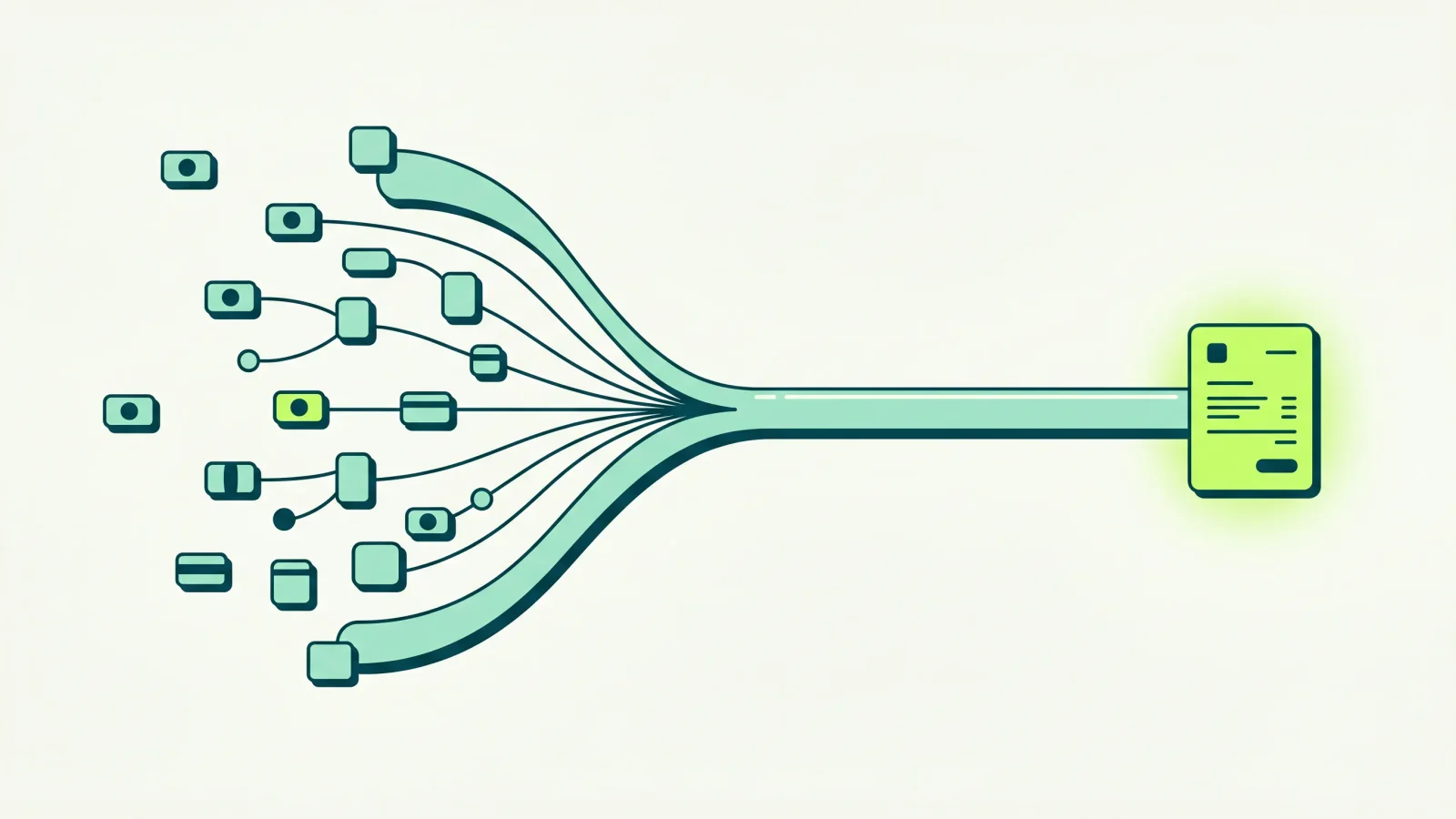
You can accept Cash App payments without a Cash App account, a partnership, or access to their API. Cash App users can send bitcoin over the Lightning Network, and Lightning (Bitcoin's payment layer that settles in seconds for a fraction of a cent) is an open standard. Accept a Lightning invoice once and every Cash App customer can pay you directly.
How can you accept Cash App payments without a Cash App deal?
You accept Lightning, not Cash App. Because a Lightning invoice is a shared standard, any app that speaks Lightning can pay it. Cash App ended 2025 with 59 million monthly active users, per Block's Q4 2025 shareholder remarks, and every one of them can scan your invoice. You never build a Cash App integration, and Cash App never has to know you exist.
This is the same logic as email. You do not sign a deal with Gmail to receive a message from a Gmail user. You run an inbox that speaks the standard, and anyone on the network can reach you. A Lightning invoice is the payment equivalent: one open format that every Lightning-enabled wallet and app already knows how to pay.
| Card processor | Lightning invoice (Cash App payer) | |
|---|---|---|
| Fee per transaction | 2.9% + $0.30 (Stripe's published pricing) | Typically little to no fee |
| Settlement | Next business day or later | Seconds |
| Chargebacks | Yes | No, payments are final |
| Work to reach a new payer | A new integration or processor | None, the standard is already shared |
Why does a Lightning invoice let you interoperate with anyone?
A Lightning invoice is a self-contained payment request defined by the BOLT 11 payment-encoding specification. It encodes the amount, a description, and a cryptographic hash into one string. Any wallet that implements the spec can read it and pay it, which is why a single integration receives from Cash App, Strike, and every other Lightning sender at once.
That shared standard is the whole point of the network. The Lightning Network specification describes the system it defines:
a layer-2 protocol for off-chain bitcoin transfer by mutual cooperation, relying on on-chain transactions for enforcement if necessary.
Standards collapse integration cost. Without one, reaching N payment apps means N separate integrations, each with its own API, auth, and maintenance. With one, you implement the spec a single time and the count drops to one. The payer's app does the translation, so the rail stays invisible to your customer.
Does Cash App actually support Lightning payments?
Yes, for both sending and receiving. A Cash App user opens the bitcoin tab, scans your Lightning invoice, and confirms the send from their balance. Cash App's Lightning help page states it directly:
Cash App is integrated with the Lightning Network, and you can use Lightning to send and receive bitcoin on Cash App.
Two limits are worth knowing. Cash App documents a cap of up to 999 US dollars in bitcoin every seven days over Lightning, and the feature is not available to customers in New York. For most checkout and invoice amounts this is invisible, and a customer on a Lightning-native wallet has higher ceilings. Note that Cash App Lightning is not the same as Cash App Pay, a separate card-style checkout button unrelated to Bitcoin.
How long does it take to start accepting Cash App payments?
An afternoon, because the hard part is already solved by the standard. The honest catch: the Lightning invoice format is free, but running the infrastructure behind it is not. A production setup needs a node with uptime, channels with inbound capacity, and routing that finds a path to the payer. That operational layer is the real work, and it is what most teams underestimate.
This is the layer Amboss runs for you. You call a managed API to create invoices and confirm settlement, with no node to operate and no liquidity to babysit. The receive flow and a code example live on the dedicated guide to accepting Lightning payments from Cash App users, and live network capacity and routing data are published on the Amboss Space Lightning explorer.
Amboss Payments is the product that turns "an afternoon" from a slogan into a setup time. It gives you Lightning receiving as a managed service, so accepting a Cash App customer is the same one-time integration as accepting any other Lightning sender. Pricing, settlement, and the API surface are documented in the Amboss Payments API documentation. It does not give you a Cash App business account, because you do not need one: the standard is what connects you.
Frequently asked questions
Can I receive money from Cash App users without a Cash App account?
Yes. You never touch Cash App. You accept Lightning through a payments API, the customer sends from their Cash App bitcoin balance, and the payment routes to you over the open network. No Cash App business account, API key, or partnership is required, because the Lightning invoice is a shared standard both sides already speak.
Is accepting Cash App payments the same as accepting Cash App Pay?
No. Cash App Pay is a checkout button that draws from a Cash App balance or linked card and has nothing to do with Bitcoin. The Lightning feature is a separate part of the app that sends and receives bitcoin over the Lightning Network. Accepting Lightning lets you receive the Lightning payments, not the Cash App Pay button.
How much can a Cash App user send me over Lightning?
Cash App documents a limit of up to 999 US dollars in bitcoin every seven days over the Lightning Network, and the feature is not available to customers in New York. For larger or recurring amounts, a customer using a Lightning-native wallet has higher ceilings. The same invoice you show a Cash App user works for those wallets too.
Do I have to build a separate integration for each payment app?
No, and that is the advantage of a standard. A Lightning invoice follows the BOLT 11 specification, so one integration receives from Cash App, Strike, and any other Lightning-enabled app. The payer's wallet handles its own side, so adding a new sender to your addressable base costs you nothing.
What is the real work in accepting Lightning payments?
The invoice format is free and standardized. The operational layer is not: a node with reliable uptime, channels with inbound capacity, and payment routing that reaches the sender. Running that yourself takes weeks. Using a managed API like Amboss Payments reduces it to creating invoices and confirming settlement, which is why setup can take an afternoon.