
The first question a finance team asks about Bitcoin payments is about price movements. It is a fair question. The short answer is that a business accepting payments over Lightning does not have to hold bitcoin at all.
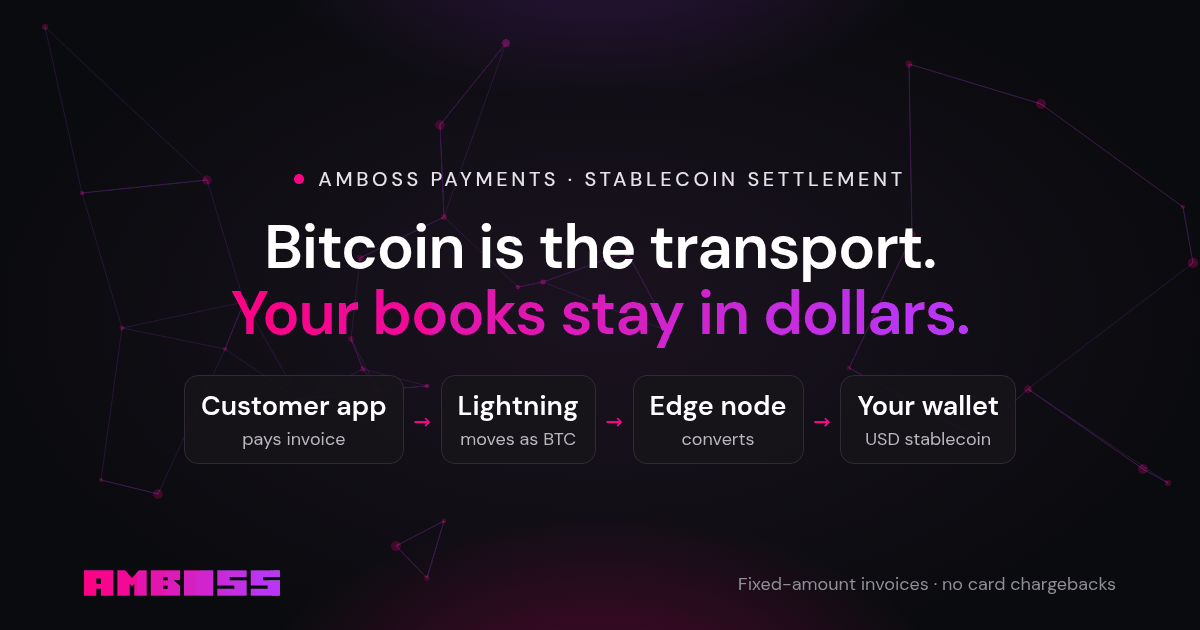
On Lightning, bitcoin can act as the transport layer. The customer pays from an app they already use, the value travels across the network as bitcoin, and the business can receive US-dollar stablecoins. This post explains how that works and what remains a decision for your team.
Who this is for
This is written for CEOs and Directors of Payments at businesses where card acceptance is expensive, restricted or unreliable, such as iGaming, adult entertainment and other high-risk categories. In those businesses the payment method decides whether a customer can deposit at all, and the settlement asset decides how much exposure the treasury carries.
How stablecoins reach Lightning
Stablecoins and other assets reach Lightning through Taproot Assets, a protocol that lets assets be issued on bitcoin and moved over Lightning channels. Multi-asset Lightning went live on mainnet with the Taproot Assets v0.6 release on 24 June 2025.
The middle of the network does not change. Routing nodes forward ordinary bitcoin payments and do not need to know that a stablecoin is involved. Conversion happens only at the edges.
What an edge node does
An edge node sits between a stablecoin holder and the rest of the network. It holds an asset channel with its client and bitcoin channels with everyone else. When a payment arrives, it converts between the asset and bitcoin at a rate it quoted in advance, and forwards the value.
According to the Taproot Assets documentation, this conversion is non-custodial: the edge node swaps the asset without holding customer funds. A receiver can also combine up to 20 incoming asset channels from different edge nodes, so no single edge node has to carry every payment.
The flow for a business
- Your system creates an invoice for a fixed amount. This is the amount you receive.
- The customer pays from the app they already use, such as Cash App, Coinbase, Kraken, Binance or Strike. Supported assets and availability vary by wallet and region.
- The payment crosses the network as bitcoin. The payer covers routing and conversion fees, so the invoiced amount arrives in full.
- Funds settle to your own wallet. Your receiving wallet determines the settlement asset. With optional auto-conversion, that can be a US-dollar stablecoin.
- Your application receives a confirmation through the API and completes the order or credits the balance.
Amboss provides the technology that connects payment requests and confirmations to your checkout. Amboss never holds, receives or proxies your funds.
Sending: request for quote
When your business sends a payment, for example a customer withdrawal, a refund or a partner payout, conversion uses a request-for-quote (RFQ) process. Edge nodes quote a price up front and compete for the volume. The default edge-node price is 15 basis points, and it varies with market conditions.
Because the quote is agreed before the payment is sent, your system knows the conversion cost at the moment it commits to the payment.
What your team still decides
Settling in stablecoins removes the need to hold bitcoin. It does not remove every treasury decision. Your team still chooses:
- which stablecoin to hold;
- how long to hold it before moving it elsewhere;
- how and when to move balances into a bank account.
These are the same questions a treasury team asks about any balance held outside a bank. We can help you work through the receiving wallet and supported payment routes for your setup before you launch.
Summary
The customer pays with the app they already have. The value moves as bitcoin. Your balance sheet can stay in dollars. Completed payments are final, with no card chargebacks, and refunds are new payments sent under your own policy.
To see how this would fit your checkout or cashier, read how Amboss Payments works or talk to our team. For the protocol background, see how Lightning handles multiple currencies.
Sources
- Amboss, How Lightning handles multiple currencies: Taproot Assets v0.6 release on 24 June 2025, edge-node role, non-custodial conversion per the Taproot Assets documentation, up to 20 incoming asset channels, request-for-quote pricing.
- Amboss Payments home page, amboss.tech: wallets customers pay from, receiving wallet determines the settlement asset, Amboss never holds, receives or proxies funds, no card chargebacks (accessed 2 November 2026).
- Amboss Payments product terms: fixed-amount invoices, payer covers routing and conversion fees, optional auto-conversion to US-dollar stablecoins, RFQ on send with a default edge-node price of 15 basis points that varies with market conditions.